


Is Idea, Execution or Timing Most Important for Success?
Years before I started getting involved in entrepreneurship and before I even knew that entrepreneurship was its own sort of niche industry, I thought that simply great ideas defined a successful entrepreneur. I know today that I was wrong, well sort of.
Years before I started getting involved in entrepreneurship and before I even knew that entrepreneurship was its own sort of niche industry, I thought that simply great ideas defined a successful entrepreneur. I know today that I was wrong, well sort of.

In college I had a lot of great ideas. I even kept a notebook of them and overtime it grew to several pages. The ideas seemed to just keep coming. Everywhere I looked I saw problems and sometimes shortly after I would see a solution in my mind. As time went on, I started following the technology industry very closely and discovered how fast the industry could generate very viable solutions in the market. From the outside looking in it seemed that people were having an idea today and had a product out on the market within the next month.
What I didn’t know at that time was just how much it took to get from the idea stage to something real and tangible. I underestimated the challenge of creating something from nothing. Now that years have gone by, I recently took the time to read back through that list of ideas I had created. I was surprised to see that since then most of the ideas on that list have actually come to market and that they now exist due to the hustle of other people in the world. I realized two things from re-reading my old list:
- My old ideas were on average about three to seven years ahead of the time they came to market.
- About 80 percent of them now exist in the world.
These two realizations led me to realize how important some of the lessons I have learned over the years are.
Lesson one: The idea. A great idea is important. You have to constantly fall in love with problems you see around the world. Once you fully understand the problem and the users it impacts you can begin to work out solutions to test. You also have to follow the market you want to make the biggest impact in. This means really understanding where it is going, as well as where it has been so you can lead your idea in the right direction. Does this idea make sense and has it been done before? Other important factors are due diligence and constant refinement from user feedback. Make sure you love the idea and everything around it or you will struggle down the road. A great idea is important, but as you will see it is not the only thing that matters.
Lesson two is timing. Ideas can come too early or too late. Having an idea early can be advantageous as it gives you first mover advantage. Getting the timing right of when to bring an idea to market is truly underestimated. Being too early can be the kiss of death, ask Myspace or Google Glass. In the case of Myspace we have the luxury of hindsight and know Facebook was better timed. In the case of Google Glass we are in the midst of seeing what happens in real time when an idea is too early. Google Glass and other wearable technology are going to come to the masses in the next 10 years. The wearable device industry right now could be compared to where the mobile phone industry was with the pre-iPhone Palm Treo about ten years ago. The counter to being too early is obviously being too late with an idea. In this case you will most likely struggle to steal market share from the preexisting big players. Lesson two is to get the timing of your idea right. You have to find the right time of when your idea can make the biggest splash in the market as a product.

Lesson three: Execute. Just go for it! Timing and great ideas are completely useless if you never do anything with them. The ability to execute is what separates great entrepreneurs from people with good ideas. Odds are that you’re not the only one with great ideas too. As stated above about 80 percent of some of my best ideas got developed and it was not by me. Other people executed on their ideas. Even though I was able to guess what was potentially coming to the market three to seven years in the future because I followed the technology industry news very closely it didn’t matter. This is where the competition heats up. Whether or not you can beat the competition will depend on your ability to time the first mover advantage while you put forth an overall commitment and passion for the idea you are building.
It appears that execution can be just spinning your tires without a great idea or timing. Timing is useless if you don’t have a great idea and don’t do the work. An idea is worthless without working to bring it to the world at the right time. So in this complex version game of “Rock, Paper, Scissors” that’s more “Idea, Timing, or Execution” what is the right ratio? In my current opinion the perfect recipe for a successful entrepreneur would be the following:
- 15 percent timing
- 20 percent intelligent, high quality and excellent ideas
- 65 percent ability to fully execute on ideas
Imagine not just the idea, but ask yourself if it is the right time and then make your plan to execute on it. You need the right blend of idea, timing and execution to make a successful idea manifest itself in the world. All three skills are a requirement for success. I am not saying this is the only ratio that will enable success, but this is what I would want to see to most confidently know success is around the corner. What do you think is the most important factor in determining a successful entrepreneur? Let me know on Twitter @TheSiskar.
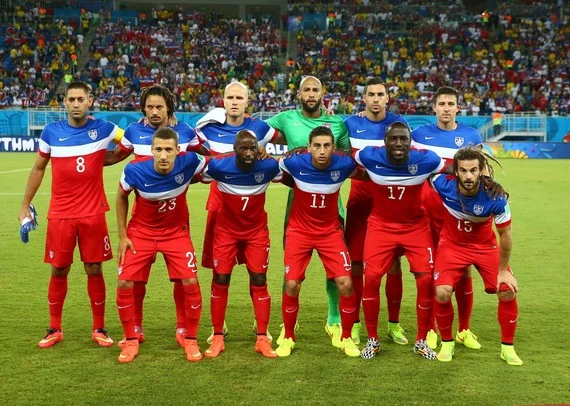
What the US Men's Soccer Team Has Taught America
As previously discussed on The Herd Report; I got to experience the atmosphere in NYC and around the world first hand during the World Cup. It was electric like I have never seen it before, especially coming from a bunch of Yanks watching soccer.
As previously discussed on The Herd Report; I got to experience the atmosphere in NYC and around the world first hand during the World Cup. It was electric like I have never seen it before, especially coming from a bunch of Yanks watching soccer.

When Landon Donovan lead the American Outlaws on their 2010 run in the World Cup people were paying attention but it was mainly just soccer enthusiasts watching. It appears now though, that the excitement of the 2010 World Cup set the framework for soccer to grow over the last four years. In 2014 something has happened to soccer in America that simply wasn't there before. ESPN has said recently that "overall viewership for the World Cup is up 44 percent over 2010.
The USA-Portugal match during the 2014 World Cup registered 18.2 million viewers on ESPN, with the USA Belgium match surpassing 20 million. This surpasses the viewership numbers of other events such as MLB's World Series, the NBA Finals, and the NHL Finals.
I love American sports and I love my teams. Being a fan is fun. However, the one annoying part of being a fan at times can be the other teams fans. With the World Cup though, it didn't matter if you were from New York or Los Angeles. You were American and we all had each others backs. The World Cup brought back to America a sense of nationalism I haven't felt in several years. During all this shared excitement between almost everyone I think it is safe to say that the US Men's team taught America a few lessons.
We learned that Goalkeeper Tim Howard is The Man and according to twitter that we want him to run for president in 2016.
"Tim Howard for president" - 10 tweets about new US hero http://t.co/uht4hwurLM pic.twitter.com/iOaJM5byu9
— BBC News (World) (@BBCWorld) July 2, 2014But that President Obama called Tim Howard to tell him to shave his beard and that the position of secretary of defense has already been filled, even if he had a record setting 16 saves against Belgium.
#USMNT @Clint_Dempsey and @TimHowardGK got a call from President Obama earlier today in São Paulo. pic.twitter.com/Vm21OhxHqX
— U.S. Soccer (@ussoccer) July 3, 2014We also learned that Clint Dempsey is unstoppable on the pitch (President Obama called him too). Dempsey showed that he won't back down even if he gets kicked in the face and breaks his nose.
The United States also advanced farther in the tournament than England after coming out of the challenging group of death; reminding all American's just in time for Independence day whose still in charge 238 years later.
Coach Klinsmann showed us that while he initially annoyed America by not giving Landon Donovan a roster slot, publicly denounced the teams ability to win the whole tournament, and is not a big fan of MLS players; that he actually knows what he is doing. He brought together a US Men's team that could compete on the global stage and gain the attention of the world. This is a tremendous accomplishment considering the global opinion is normally that American Soccer cant complete with other countries on the pitch.
Most importantly we learned that if the 2010 World Cup run set the stage for this much excitement in 2014, The United States is well on its way to becoming a soccer nation in the coming years. 4 years from now the 2018 World Cup is going to be incredible. In 2018 it is safe to say that most of America will once again and more confidently be saying:

The Future
I recently finished reading Physics of the Future by Dr. Michio Kaku. After countless hours of time spent with the smartest scientists on earth, Dr. Kaku's book chronicles predictions for the coming world between now and the year 2100.

I recently finished reading Physics of the Future by Dr. Michio Kaku. After countless hours of time spent with the smartest scientists on earth, Dr. Kaku's book chronicles predictions for the coming world between now and the year 2100.
We have all learned about globalization and seen its effect over recent years. It is now clear to me, though, that human progress will not simply stop at various nations getting along. As we work up the Kardashev scale toward a Type 1 civilization and leave behind current Type 0 civilization a shift beyond world peace could happen in the next few generations. Eventually, around the year 2100 or shortly after, the existing nation borders could actually dissolve away. Society could become a planetary civilization in the next few centuries. This is an exciting and scary proposition, especially considering the world is currently predominately driven by capitalist economies that benefit from competition in the markets. This future that Dr. Michio Kaku lays the framework for will be a major shift from our current society. While reading Physics of the Future one thought seems to keep reoccurring: We have to get this "better future" right. The stakes are high and there is not likely a second chance for society if we mess the future up on a global scale.
Over the past century, society has already begun the transition from a working economy to an information economy. Now, as the early stage proliferation of the Internet continues to mature, we are beginning another transition from an information economy to a newer wisdom economy.
The quality of information and not the quantity of information will be the focus in the future.
Mass data collection continues to constantly grow in the background and needs to be digestible. As big data continues to get bigger and bigger, a new product focus on wisdom will be the only way to drink from the fire hose of information we are dealt on a daily basis. In order to cross the gap into the future, society will need to be responsible with not only the environment but also humanity across borders. By shifting from an information economy to a wisdom economy and overcoming the challenges associated with that shift it should allow society to level up on the Kardashev scale.
The thought of failure of this challenge can be haunting at times while reading Physics of the Future. However, Dr. Michio Kaku had an answer for this haunting thought that was surprisingly incredible. Nothing sums the solution to this rough transition ahead more than the quote that Dr. Michio Kaku closed the book with:

"The Roots of Violence:
Wealth without work,
Pleasure without conscience,
Knowledge without character,
Commerce without morality,
Science without humanity,
Worship without sacrifice,
Politics without principles."
- Mahatma Gandhi, 22 October 1925
I found Gandhi's wise words to be invigorating and almost 100 years after he said them, still refreshingly accurate. They will be more important than ever as society approaches a time, for example, when work the way we know it may not be as necessary due to future robotics and computers. A few of the characteristics defined by Gandhi will change and while they do it will be the responsibility of individuals to keep in mind the character built by them.
Personally, I cannot wait for the future ahead of us. It will be one crazy ride. We can let this ride terrify us while we will fight it, or we can embrace it and enjoy it. Either way, the fact is we cannot make the world stop and stand still where it is. Progress will forever be marched forward by others in the world around us. Therefore, I suggest the latter. So, while we enjoy the ride up to the year 2100, let's try to remember those words Gandhi spoke almost 100 years ago.

Why in 2014 Buffalo is a (Sports Teams) Dream Location
As we know, in other places across the planet Buffalo does not always have the best reputation of itself. Our sports teams are at times

As we know, in other places across the planet Buffalo does not always have the best reputation of itself. Our sports teams are at times laughed at and our economy is well, lets just say “rust belt-ish”. While I cringe every time I hear these claims shouted at my hometown it is hard to deny they are not sometimes routed in truth, especially for the first decade of this new millennium.
Now Buffalo seems to be divided. There is the first faction who faithfully follows where ever the city and its teams lead them. They sell out one of the largest football stadiums in the nation even as the Buffalo Bills missed the playoffs for the 14th season in a row. Then we have the other faction. This consists of those who have fallen out of the former group. Those people who due to the process of constant disappointment have fallen victim to a mood of permanent and lasting skepticism.
I do my best to stay up to date with the happenings and news in Buffalo while watching everything develop from New York City. Lately it has begun to appear to me (a person living in the world outside WNY, looking in) that the winds are changing in Buffalo. Slowly, sometimes slower than I would like, it appears things are turning around for the better in Buffalo.
Investors will tell you to never ignore a market when it is in a recession. That is when you can buy in at a time when the market has currently undervalued its goods. Goods can only become so cheap in a region before investors see growing opportunity to buy in at the bottom level and maximize potential profits. This is what appears to be happening in Buffalo. Forbes recently validated this is the case in the Western New York Region when it named Buffalo the Most Affordable City in America.

HARBOR CENTER
A few examples: recently 43 North has launched a $1 million dollar prize to attract start ups to fill the cheap and available office space downtown. Avant Buffalo has spent $85 million building up luxury condos and office space. Gov. Andrew M. Cuomo has pledged the Buffalo Billion to the Region.Chippewa Street is becoming classy. And to get to my point, Terry Pegula has bought the Buffalo Sabres and is now also building the Harbor Center.
As Warren Buffet says “Be Fearful When Others Are Greedy and Greedy When Others Are Fearful”. Terry Pegula knows this is and is doing what all the rest of the investors are doing in Buffalo. He saw a market opportunity to buy in at an all time low price and did just that. Just as many smart investors, who are now very rich, did just after the .com and housing bubble’s burst.
““Be Fearful When Others Are Greedy and Greedy When Others Are Fearful”
”
In the case of Forbes naming Buffalo the most affordable city in America we can see that might not be the best image for Buffalo currently. The most powerful cities tend to correlate with the most expensive ones. Just visit New York City or London. However, this weak perception can also be a strength. Just ask Malcolm Gladwell who’s new book underlines the advantages and importance of being under rated. It is definitely a sign that the opportunity to invest in the region is happening now and investors recognize this. This affordability can be an opportunity for Buffalo Sports too. A great example of this was recently pointed out by Buffalo Down:
- Players can live like royalty in Buffalo for far less than most NFL cities.
- $7 million in Buffalo is like $9 million in Houston, or Dallas, or pick your “Big Market Team”.
So affordability gives us the potential opportunity to attract bigger talent at lower contracts.
Buffalo now finds itself where it lives best; as the Underdog. Terry Pegula bought in on the ground floor and stands to make a lot of money over the next 20 years, while his investments ride out. The best part of this is that he will most likely bring the city and the teams along for the ride with him. We are at a catalyst moment in Buffalo. The key to making the opportunity ahead of Buffalo have a long lasting and perpetual growing impact is that we all get on board and realize it is happening. There can be no more skepticism and false beliefs. Now is a time for action.
So in the next few months as you live in Buffalo, do yourself a favor and look around. Take it all in and remember the Buffalo of now. I believe after years of watching Buffalo just get by, both economically and in the world of sports, it is time we all stop just circling the wagon and finally get on board full speed ahead!

About Brett Siskar
“If you can dream it, you can do it.” — Walt Disney

Brett Siskar is actively advancing his education in business administration to compliment his background in engineering. He efficiently analyzes and breaks down existing barriers to solve distinct problems. Highly skilled in spatial analysis, Brett Siskar's previous experience includes an engineering internship at military defense company Northrop Grumman. Also, he is currently an expert in 3D Printing, computer-aided design (CAD), and manufacturing.

A New Philosophy: The Future of Mobile Computing
I have decided that it is time to lay out my philosophies regarding the tech industry in the next few segments posted here. I have been following the tech industry

I have decided that it is time to lay out my philosophies regarding the tech industry in the next few segments posted here. I have been following the tech industry for a few years now and during which I have noticed several major macro-economic trends are developing and yes, I used the word macro-economic. I find these facts fascinating, however I will not blame anyone if you don’t share my enthusiasm. Here we go.
MOBILE
Now I know that mobile being the future is usually a gimme and very obvious. However, I feel that most people understand the way mobile is progressing into the future incorrectly. To start we need to lay down some numbers for a foundation. The human population of planet earth hit 7 billion as of March 2012 and is growing. There are 2.5 billion people on this planet that currently have access to the internet and there are 5 billion people with wireless cell phones. The current majority of those cell phone users having what we will call “dumb” phones for lack of a better term. It is important to note that the iPhone and most Android smartphones are now a few years old. If you connect those data points you will see that most older smartphone models which are connected to the internet are now being offered as the free phone by carriers to customers who want to upgrade from their “dumb” phones. These carriers use mostly two year contracts with their customers.

Therefore in the next two years, it is predicted that the actual population of the Internet will almost double thanks to new smartphone users coming online in various countries around the world with their new internet connected mobile devices. That’s not even including the 54.8 million tablets now online that didn’t even exist four years ago. It’s pretty incredible to think that the internet is only half the size of what it will be in just two years time, even though it’s been over 20 years since Tim Berners-Lee invented the World Wide Web at CERN. This single statistic shows that the internet as we have experienced it thus far is only the very beginning. The way the internet is experienced, looks, and interacts with human life is going to evolve drastically going forward in time.
There is a second part of the mobile renaissance that is misunderstood as well. Mobile devices won’t be the only devices used in the future. To clarify, mobile devices are referring to both tablets and smartphones, as opposed to PC’s, desktops, and gaming consoles. All of these devices matter and will be used together. There is a major reason why and my next theory/post will show you why.
To be continued…

You Only Live Once
Here we are at “The Starting Line”. Life is a blank slate in front of us. We only get one shot at this thing called life, and if there is one thing this generation knows

Here we are at “The Starting Line”. Life is a blank slate in front of us. We only get one shot at this thing called life, and if there is one thing this generation knows it is that we were raised to never waste a moment of it; to make the most out of every moment and follow our dreams.

YOLO. Extremely cliche but the question still remains, what will we do with our life? Our elders think that we expect too much out of life. That there is a work ethic epidemic. I disagree with that belief. What has happened is that the incentives which motivate a work ethic in younger generations has changed very rapidly in the past decade and at a pace with which many corporations and managers have failed to keep up. The world is more connected than ever, and is exponentially connecting even quicker. This is the first generation to know the existence of, to use, and to understand the repercussions of the Internet. It has always existed in our lives. Where to older generations it is simply another new thing that has come along. However, we are digital natives to this new world of technology. This means we see opportunities and have access to knowledge that our elders only dreamed of having at our age. To think that extreme alteration in mentality won’t have repercussions in the structure and organization of a workplace is naive and what those elders fail to realize is that an entire generation now has this new mentality. And yet, another sub generation still in high school has that mentality even stronger than those coming out of university. YOLO… Yes, this is a fad attributed to a rap song by Drake and true its use in pop culture has diminished its value, but it still has meaning. It’s a reminder to all people of their own mortality and it is a signal to all who are listening that we as a society are beginning to see a shift in paradigms.
In the past, older generations were paid and rewarded with the currency of money. But the future generation doesn’t see money having that same value to them. It’s value is not absent entirely, just very diminished. Younger generations prefer compensation in the form of life experience and personal time. They know “You Only Live Once”. This isn’t to say that the younger generations don’t have the will to work like their elders believe. It just means they don’t have the will to work for things they don’t believe strongly in and that won’t immediately contribute significant experience back into their lives. Time is the new commodity to be traded. In corporations of the future, flexibility could become the main corporate benefit. There is already a growing trend in the availability of flexibility to employees. More and more companies are adopting new technology which gives their employees the ability to work from home, push papers as they attend their relatives 4th of July BBQ, or send an email before they jump from the top of a cliff while living their dream of base jumping.
The companies that fail to acknowledge this shift in paradigms will pass away with those older generations. Corporations that wish to stay alive and avoid extinction will have to be as nimble and agile as these new generations are. Generation Y (born 1980's), Generation Z (born 1990's), and Generation AO (born 2000's) will each be more plugged in than their predecessor and exponentially more plugged in than the older dinosaurs who will inhabit the executive positions within the corporations that hire them. The new exchange system where money is a second best for employees, compared to the ability to gain individual experience will become the norm over time; regardless of if elder generations like it or not. The truth is that there is a new breed about to make their ascent in the modern world. We understand technology in a way that no others have before. This will be our upper hand in the world. Those who fail to embrace the new societal norm will not truly attain greatness in the world. To borrow a word from @Jason,
““Those who fail to strive for greatness will be the rice pickers and the people who do understand the new laws will be the samurais”.”
This is the Starting Line. I’ll ask you one more time. What do you plan to do with your life? I plan to get to the Finish Line. I hope to see you there…

About Kevin Siskar
“You have to learn the rules of the game. And then you have to play better than anyone else.” — Albert Einstein
Short Bio: Kevin Siskar is director of the start up accelerator, The Founder Institute, in New York. He is also the Founder of Brinkway. He applies his degree in Cognitive Neuro-Science, the analytical combination of Neuroscience, Philosophy, Psychology, Linguistics, and Artificial Intelligence, to enable the capacity for innovative problem solving and insights to unique challenges. He has energetic passion for creating new alternatives to identifying hidden obstructions that negatively impact growth. Inventive analytical perspectives from cognitive science have allowed him to pursue multiple aspects of data for innovative outcomes. Previously Kevin worked as a Technology Researcher for Jason Calacanis' Launch Ticker, which served as the inspiration for the new Inside.com.
Long Bio: http://www.siskarsolutions.com/about/