A.I. Factories Are Coming
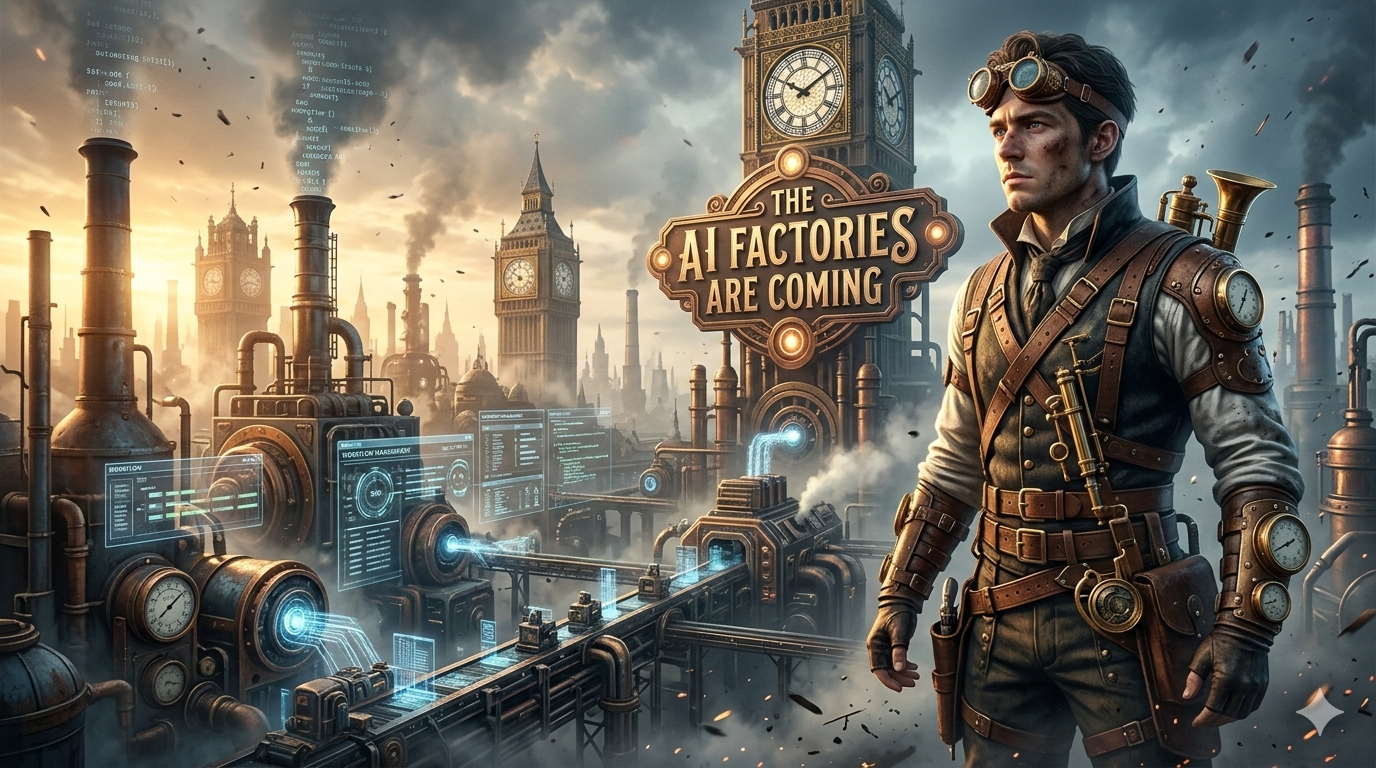
Machines specialized to the factory floor; I think software will specialize to the workflow floor.
For most of the last 40 years, software has felt like this:
A company buys apps.
People learn the UI.
Work bends to the software.
But I think AI flips the relationship. We are entering an era where software needs to bends to the work. And this is possible for the very first time thanks to an AI models ability to “reason”.
Not because “anyone can code” (though that is suddenly closer to true than it has ever been), but because the cost of turning intent into working software is collapsing. And this is not the first time this has happened.
The Industrial Revolution did the same thing for turning raw materials into physical goods. In both revolutions, the headline is not “things got cheaper.” The real story is who gets to build, what becomes commoditized, where value migrates, and which layers become defensible.
The Signal
Last year Klarna, a public fintech company, publicly said they stopped using Salesforce internally because they built their own in-house version. And the internet translated that into “AI replaced SaaS.” The more accurate read, based on the CEO’s clarifications, is that Klarna consolidated a sprawling software stack into a unified internal knowledge and workflow layer. The point is not that Klarna “swapped Salesforce for a chatbot.” The point is that AI made it economically rational to internally build company specific systems that used to be too expensive to justify building and maintaining.
A similar signal is showing up in workforce decisions. Jack Dorsey’s Block announced layoffs recently while explicitly framing “intelligence tools” as part of the productivity equation. Whether you agree with the decision or not, the posture matters: leadership teams are starting to treat AI productivity as an operational lever.
If you are a software buyer, this changes your default question from “Which tool should we buy?” to “Should we buy this at all, or should we build an internal version that matches our workflows?”. So this got me to thinking. When has this happened before in human history. When did rapid improvements in automation completely change how companies operate internally.
The Industrial Revolution
Taking off in the late 1700’s, the factory was not just a building with machines. It was a new way to build a company.
Standardized parts, repeatable processes, quality control, floor supervisors, supply chains, and distribution all mattered as much as the machines themselves. The big unlock was the ability to chain machines into a reliable production line, and then continuously improve the line.
Once that happened, two shifts followed quickly:
First, production became less about individual craft and more about overall system design and operations across the whole factory.
Second, value moved toward the layers that scaled: distribution, logistics, financing, brand, and the ability to run a high quality, high uptime operation.
The AI Revolution
Modern companies do not run on machines. They run on workflows.
Sales is a workflow. Support is a workflow. Hiring is a workflow. Fundraising is a workflow. Most “software” is really a set of screens trying to corral messy human reality into a predictable sequence of buttons to add new data, and dashboards to display existing saved data.
AI changes the unit economics of that sequence. Instead of forcing work through rigid screens, you can express intent and constraints, and the system can generate the next step: the outreach, the doc, the follow up, the analysis, the handoff. Over time, that behavior can adapt to how your business actually operates.
This is the key tension that will define the next decade.
Agents are the new machines.
The winner won’t be the tool with the prettiest UI. The winner is the system that adapts to the workflow and remains governable. An AI factory of agents taking inputs and producing outputs. Where software engineers are the new floor supervisors, guiding the agents to keep the production line moving.
What Tools Survive In This New World?
When software becomes cheaper to create, survivability depends on what layer the tool truly owns.
A simple map helps:
Systems of record (truth): saved data, audit logs, access permissions, compliance.
Systems of internal coordination: chat, tasks, approvals, shared knowledge.
Systems of external distribution: the default place work begins (inbox, browser, operating system).
Systems of action: automation and execution across tools.
Tools that are mostly “UI around a database” are the most exposed. Tools that own truth, governance, integrations, distribution, or network effects have much stronger survival odds.
Take GitHub for example. Even if AI changes how code is written, GitHub is not just a UI for codebase repositories. It is an ecosystem with deep integration surface area, security and governance expectations, and a workflow standard for teams. That is hard to reproduce in a way that users trust.
Generic CRMs like Salesforce are perhaps more nuanced. The UI layer is vulnerable because dashboards and data entry are cheap to rebuild. The sticky parts are the relationship identity graph, governance, event streams, integrations, and the organizational truth that accrues over time. Many companies will build internal workflow layers on top of CRM backends, and the large CRMs will survive by becoming substrates, or an underlying layers that are ready for agents to plug into them.
Slack has a similar split. Basic messaging UI is easy to recreate. What is not easy is becoming the default coordination hub with the integration fabric, enterprise controls, and institutional memory that teams rely on. AI also shifts the interaction model: less “talking in channels,” more talking to an agent that uses channels.
Intercom and other customer support platforms are heading toward a focus on outcome competition. Intercom now charges per successful interaction it’s AI Agent Fin has with a support ticket. If Fin can resolve the support ticket without a human, it gets paid.
Defensibility & The New Shape of Software
This is where a lot of people overcorrect. Software does not “die”. A large category of software becomes the underlying layer below agents. What dies is the assumption that shipping just a UI is defensible.
The winning shape of SaaS in the AI era looks like this:
Systems of record truth + agentic action + policy controls + pricing tied to outcomes
In plain language: fewer rigid screens, more reliable backends and fluid orchestration of workflows, with strong governance to ensure any autonomous behavior is safe.
To evaluate defensibility of a business, do not ask “Could we build the UI?”. Instead ask “Could we reproduce the hidden factory behind the UI?”
Here is a practical rubric you can use with any tool.
Rebuild Difficulty Index (RDI)
Score each 1 to 5 (low to high). Add them up.
Data model gravity: complexity of schema, relationships, and historical truth.
Edge case depth: how many messy scenarios are baked into the product.
Integration surface area: APIs, webhooks, identity providers, upstream and downstream systems.
Governance and compliance burden: audit, retention, permissions, regulatory requirements.
Reliability requirements: uptime expectations, incident response, SLOs, on call burden.
Distribution and network effects: ecosystems, standards, marketplaces, “default hub” behavior.
How to read the score:
12 or below: easy to rebuild (danger zone for niche UI SaaS)
13 to 19: rebuildable, but only if it compounds your advantage
20 to 26: hard to rebuild (platform territory)
27 to 30: you are not rebuilding this unless it is your core business
The most common mistake is underestimating governance and reliability as those are the costs you do not see on a product demo.
To Build or Buy Software?
In the AI era, every software purchase competes with a new alternative: “We could build the version we actually want.”
Buyers will increasingly run a simple, implicit calculation:
How fast do we get real value?
How painful is onboarding?
How disruptive is workflow change?
What is the cost and risk of building?
What is the out of the box value vs total cost to build? A useful way to think about “value out of the box” is not features. It is time to outcome. If a tool you buy takes 90 days to implement, requires major training, and produces unclear value until adoption reaches critical mass, teams will start asking why they are paying at all. Onboarding and disruption include admin time, training hours multiplied by real salaries, migration pain, and the opportunity cost of slowed execution. If the ratio is not obviously positive, the default flips toward building something smaller that works now.
When Building Is Synergistic?

Building is a competitive advantage when it compounds.
It tends to be synergistic when:
The workflow is revenue critical and repeated daily.
Your workflow is meaningfully unique, or uniquely excellent.
The system captures compounding data about what works.
The build sits at a leverage point that orchestrates multiple tools.
You can keep the surface area narrow at the start.
The best internal tools begin as one workflow loop, not a full replacement for a platform.
When Building Is A Distraction
Building can also become a trap though, when you accidentally start a software company inside your existing company. It is usually a distraction when:
The job is already a commodity or compliance heavy (payroll, accounting)
The scope expands into an infinite roadmap you then have to build (and maintain).
There is no clear operator owner with metrics and prioritization authority.
Reliability requirements force you into platform mode (24/7 uptime, audits, user permissions, security reviews, etc).
The clean strategy that wins most often is hybrid:
Buy the backbone. Build the nervous system.
Buy systems of record where truth must be maintained. Build the adaptive workflow layer that turns truths into action for your customer.
What To Do Next
If you are a founder or CEO, you can act on this without a massive re-platform. Start by treating your company like a production line, not a collection of features. In the Industrial Revolution, breakout fortunes did not come from owning a single machine. They came from designing the full system and running it better than everyone else.
Andrew Carnegie built a steel empire by industrializing production and integration. He ultimately sold Carnegie Steel in 1901 for $480 million, and the U.S. Steel merger that followed was capitalized at roughly $1.4 billion, often cited as the first billion-dollar corporation. John D. Rockefeller built Standard Oil into a dominant refining operation, controlling roughly 90 to 95 percent of U.S. refining by 1880. These were not “tool decisions.” They were operational systems that turned new technology into repeatable, scalable output.
AI sets up a similar game, but the production line is digital this time. McKinsey estimates generative AI could add $2.6 to $4.4 trillion in annual economic value across use cases. That scale is why this moment feels like a new boom. A huge amount of work is about to be retooled.

Aictory = A.I. Factory
The companies that build reliable “workflow factories” will compound speed, quality, and learning.
The Industrial Revolution lesson is still the right ending: the advantage did not belong to the people who admired machines. It belonged to the people who designed and ran the factory.
The AI era will reward the teams that can design and run the workflow factories.
Welcome to the age of the Aictory.
NOTES & RESEARCH:
AI and the software stack shift:
Klarna CEO clarifying the Salesforce story (and the nuance behind it):
https://techcrunch.com/2025/03/04/klarna-ceo-doubts-that-other-companies-will-replace-salesforce-with-ai/
https://diginomica.com/those-shutting-down-salesforce-and-workday-rumors-klarna-no-we-didnt-replace-saas-llm-admits-ceo
https://www.itpro.com/technology/artificial-intelligence/klarna-ceo-sebastian-siemiatkowski-salesforce
Klarna CEO post: https://x.com/klarnaseb/status/1896698293759230429
Block layoffs and the explicit AI narrative:
https://apnews.com/article/18e00a0b278977b0a87893f55e3db7bb
https://www.theguardian.com/technology/2026/feb/27/block-ai-layoffs-jack-dorsey
Generative AI macro value estimates (McKinsey):
https://www.mckinsey.com/capabilities/tech-and-ai/our-insights/the-economic-potential-of-generative-ai-the-next-productivity-frontier
Industrial Revolution parallels:
Carnegie’s 1901 sale of Carnegie Steel:
https://www.carnegie.org/interactives/foundersstory
U.S. Steel’s founding and capitalization:
https://www.library.hbs.edu/special-collections-and-archives/exhibits/us-steel/the-founding-of-us-steel-and-the-power-of-public-opinion
Standard Oil’s refining dominance by 1880:
https://www.britannica.com/money/Standard-Oil