


Spotify Playlist: The Come Up, Music to Motivate
The Come Up: Music to Motivate is a continually growing collection of songs on Spotify with the intention of boosting entrepreneurial motivation
The Come Up: Music to Motivate by Kevin Siskar
is my continually growing motivational Spotify playlist with the intention of boosting entrepreneurial motivation when people need it most.
Over 7 hours of motivational Spotify music to help you grind through whatever dream you are pursuing. That means if you listen to "The Come Up" only a mere 1,282 times while working toward your goals you will have achieved that epic perfection milestone of 10,000 hours.

Why Periscope Should Embrace Landscape Video
Why should Periscope embrace landscape video. The answer to this question is one word. YouTube.

Periscope App
Why should Periscope embrace landscape video. The answer to this question is one word. YouTube.
The best Scopes are done by people who know how to engage their audience via video on a mobile device. We could spend months waiting for the best Periscopers to naturally emerge in the wild and eventually nail down how to get viewers to engage on the platform. Or we could enable a group of people who have spent years perfecting the skill of engaging and curating a mobile camera experience on a day to day basis. The YouTubers. The users of a company whose very slogan is "Broadcast Yourself".
In many ways Periscope almost feels as if it should have been bought by YouTube and not Twitter. A little bit of proof that Twitter is on point with its innovation and acquisitions.
Normal everyday people are unsure of what to say or afraid to engage with the camera when on periscope. But YouTubers know their audiences and are not shy in that experience. They know how to talk to an audience and how to engage them. We love to watch them. So here is the trick.
Periscope already allows you to save a Scope to your camera role when you are done. If Periscope embraced landscape mode it would allow YouTubers to every time use Periscope to initially record their videos while engaging with users in real time, then save that video to their camera role, and finally use that video for uploading to YouTube. Create once, while directly engaging your audience, and then easily syndicate!
You can do this process currently but then you have a vertical video with black bars on both sides. And lets be honest, nobody wants to watch that. Vertical Video Syndrome is bad. And if you rotate your phone while on Periscope, as an attempted solution, you will have some very angry commenters coming at you pretty quickly because the comments do not rotate. A few simple additional UI changes when the screen is rotated could be a game changer.
Content creators on all platforms do a lot of work. They have to syndicate content and manage audiences on multiple platforms. By periscope enabling this one feature it would enable YouTube content creators to more easily use one action for multiple platforms. In return, periscope would get next level high quality content creators for its platform. It's a no brainier.

Peter Diamandis On The Power Of Thinking Exponentially
"If you want to become a billionaire then help a billion people" - Peter Diamandis

James Cameron, Peter Diamandis, Elon Musk, and others experiencing weightlessness on a Zero G flight.
I saw Peter Diamandis speak recently at the 2015 Founder Showcase. In case you didn't know Peter started the X Prize, has backed Tesla, and created the Singularity University to name a few achievements. He starts his talk with the foundation that "an entrepreneur today can touch the lives of a billion people". Peter talks about how in just 30 doublings of something you can reach the number billion.
"If you want to become a billionaire then help a billion people" - Peter Diamandis
The power of thinking exponentially and not linear has the ability to unlock a whole new world of technology and science. Peter shows this by tracking the success trajectories of companies like Kodak to Instagram across various decades. If we look at how that trajectory predicts the future ahead of us we are in for some unfathomable achievements in the world. Somebody has to start these dreams and companies. It might as well be you. So take some time and learn how to think exponentially. Watch this exclusive video below and don't forget to also subscribe to my Youtube Channel here:

Make It Count
This is a brief post but I still feel it is worth sharing. I am a big fan of Casey Neistat and all things motivational. Both of which are in this video.
This is a brief post but I still feel it is worth sharing. I am a big fan of Casey Neistat and all things motivational. Both of which are in this video. Take a few minutes and watch the "Make It Count" video Casey produced for Nike below. Surprisingly you can see a lot of the world when you blow an entire marketing budget in 10 days. And you have to love the "Do More" tattoo.

How To Create An Industry: Gabe Zichermann
Many people are concerned with figuring out how to create a successful company. To Gabe Zichermann however, he took a look back at his career and realized that while in the process of creating successful companies he had also

Gabe Zichermann
Many people are concerned with figuring out how to create a successful company. To Gabe Zichermann however, he took a look back at his career and realized that while in the process of creating successful companies he had also simultaneously been at the epicenter of a few brand new industries.
At the 2015 Founder Showcase Gabe Zichermann discusses "How To Found An Industry". Watch my exclusive video below:

Casey Neistat's Startup Lesson
If you know Casey Neistat then you know in 2015 he has started doing a vlog a day. In vlog #112 Casey shares his new startup story about BeMe Inc and how he was in the middle of fundraising at the same time his child was being born.

If you know Casey Neistat then you know in 2015 he has started doing a vlog a day. In vlog #112 Casey shares his new startup story about BeMe Inc. and how he was in the middle of fundraising at the same time his child was being born. Check it out below and in my opinion if you want to consume the most important piece of advice Casey gives, go ahead and skip to 2 minutes 10 seconds.
The only thing in life that stands between you and everything you have ever wanted to do, is doing it - Casey Neistat

What Makes a Successful Entrepreneur? Circumstance, Genetics, and Perseverance
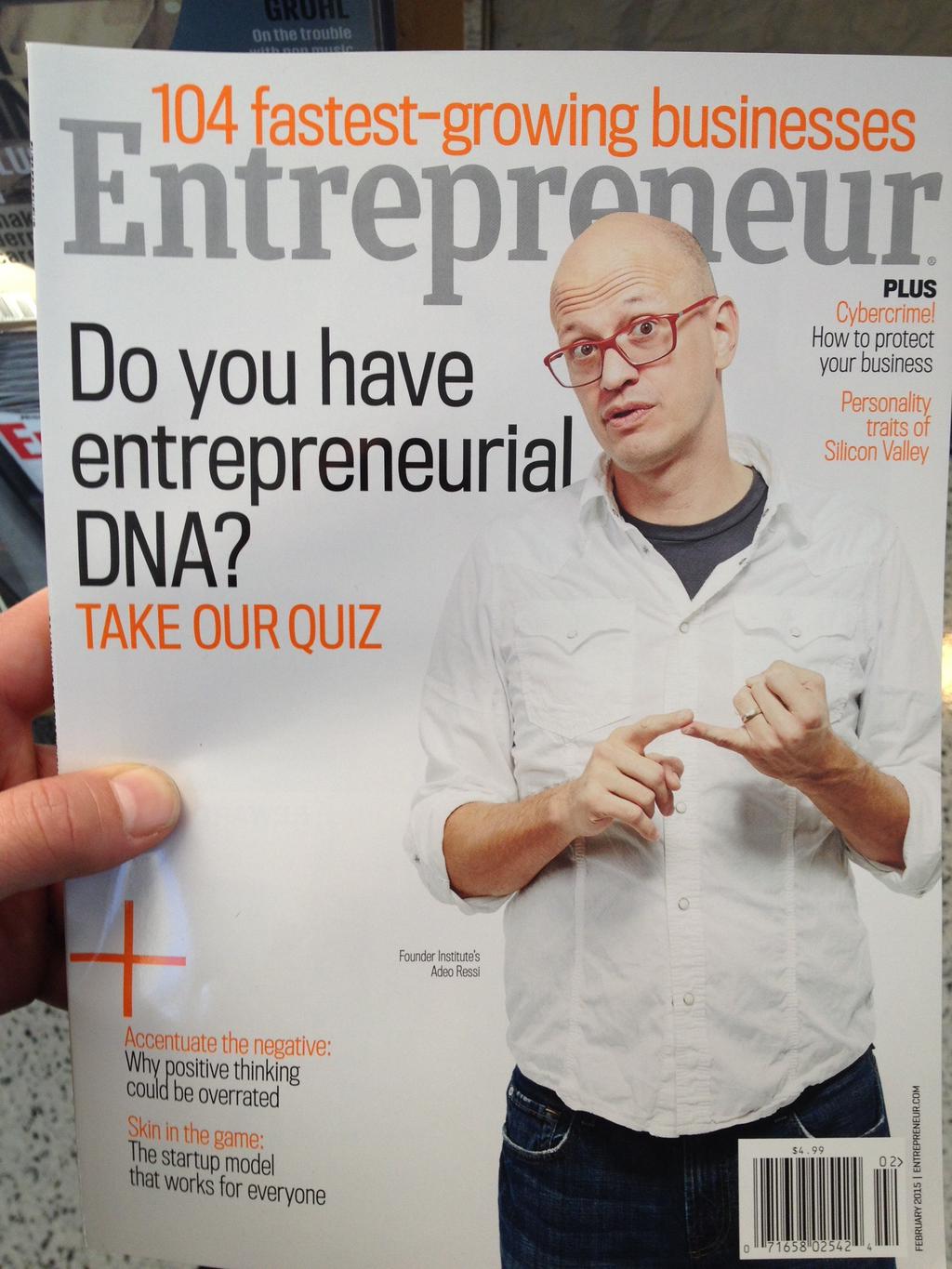
Recently Adeo Ressi, Founder of the Founder Institute, was asked, “what does it take to be a successful entrepreneur?”. In Adeo’s opinion, his answer was successful entrepreneurship is a combination of three things: Genetics, Circumstance & Perseverance.

Steve Jobs
Recently Adeo Ressi, Founder of the Founder Institute, was asked, “what does it take to be a successful entrepreneur?”.
In Adeo’s opinion, his answer was successful entrepreneurship is a combination of three things: Genetics, Circumstance & Perseverance.
Let’s go through all three.
Adeo Ressi
1. Genetics
The Founder Institute has completed social science testing on over ten thousand prospective entrepreneurs, measuring things like “Big 5 Personality Traits”, Fluid Intelligence, IQ, and more. The Institute then watched who became successful, and correlated back the measured traits that best predicted success, in a scientific process.
The traits that best predict entrepreneurial success are genetic, such as Fluid Intelligence and Openness. BUT, just because you have traits that MAY make you successful as an entrepreneur, does not mean that you WILL be successful. Similarly, just because you are tall does not mean that you are good basketball player.
In other words, you need the raw materials, but you also need other things.
2. Circumstance
Being in the proverbial “right place at the right time” matters a lot towards your ultimate success as an entrepreneur.
Timing is everything (..almost).
For example, Michael Diamant started iClips, a site exactly like YouTube, a few years before YouTube launched. iClips was a truly well-executed business, but the necessary bandwidth, camera penetration, and streaming technology adoption did not yet exist for it to gain massive traction. He was simply too early for the market.
Circumstances are not all market-specific, either. You can have perfect market-timing, but your personal circumstances might not be optimal. For example, you could have the best idea and timing while you are a high school student, and start to execute on that idea to the the best of your ability — but then a veteran entrepreneur does the same business with millions in venture capital and captures the whole market.
Some circumstances are in your control, and some are simply outside of your control, but most successful entrepreneurs will concede that some of their success is attributable to circumstance.
3. Perservance
You only fail in your business when you actually give up, so, in fact, no business would ever fail if people persevered.
When you look at the Founders of some of the most successful technology companies in the world, and there almost always were (and still are) times when the Founders simply refused to give up despite unbelievable problems, stress, and negative signaling
“Entrepreneurship is like eating glass and walking on hot coals at the same time” — Elon Musk

Elon Musk
An entrepreneur faces all of the debilitating problems of their own life, coupled with all of the personal problems of their team, as well as hostile operating environments, limited capital, stretched resources, no time, regulatory burdens, changing technology… the list is endless.
The loneliness and darkness of entrepreneurship is not discussed very often, but it is very, very real.
Those that persevere succeed. Those that do not, do not.

The Single Biggest Reason Why Startups Succeed
I was recently watching Charlie Kim, founder and CEO of Next Jump, presenting at the Founder Institute. During his talk he cited a TED talk by Bill Gross titled "The Single Biggest Reason Why Startups Succeed".
I was recently watching Charlie Kim, founder and CEO of Next Jump, presenting at the Founder Institute. During his talk he cited a TED talk by Bill Gross titled "The Single Biggest Reason Why Startups Succeed". I found the talk and enjoyed it so much I thought I would share it. You can find the link to it by clicking here.
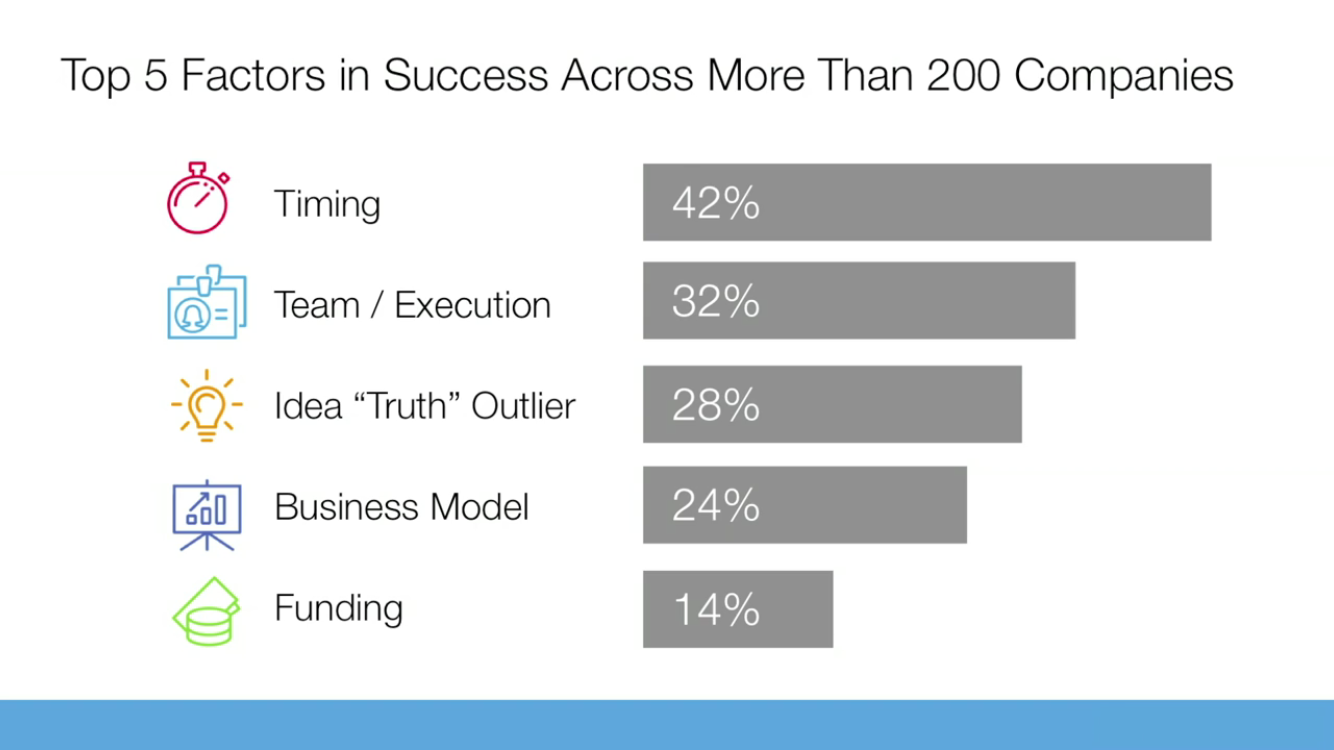
Bill wanted to find out what is the single biggest reason startups succeed. He analyzed 200 companies. For each company he looked at the business traits of Funding, Business Model, Idea, Team, and Timing to determine which traits correlated most to its success. The quick synopsis is that the Bill Gross study showed that Timing (42%) is the single most important factor in a why a startup succeeds. Followed by Team (32%), Idea (28%), Business Model (24%), and lastly Funding at (14%).
What do you think? Agree? Disagree? Let me know in the comments below.

Why You Should Tell Everyone Your Startup Idea
Entrepreneurship is hard. Really hard. But with countless tales of how entrepreneurs made it big with almost nothing, it's easy for a budding founder to jump into the startup world full of unbridled enthusiasm and some startup misconceptions.

Entrepreneurship is hard. Really hard. But with countless tales of how entrepreneurs made it big with almost nothing, it's easy for a budding founder to jump into the startup world full of unbridled enthusiasm and some startup misconceptions.
As Director of the Founder Institute in New York one of the more common misconceptions I encounter with a lot aspiring entrepreneurs is that they are afraid of telling others their idea. There are numerous reasons though why entrepreneurs should share their startup ideas. While it is common among founders to be hesitant about divulging their startup secrets, the truth of the matter is that your company can benefit greatly from telling people what your idea is about and what you hope to achieve.
Myth #1: "I Should Save My Startup Idea Until It's Refined"
Reality: You should share your idea with everyone you meet. If you plan on pitching your idea to potential investors, why not practice beforehand? By sharing your idea with as many people as possible, you can get feedback early on to prevent wasting time on an idea that won't sell. In a Courtney Seiter-penned article titled Why No One Will Steal Your Startup Idea, Buffer CEO and Co-Founder Joel Gascoigne says:
"When you build a startup, you're basically creating something that doesn't exist already. In order to figure out if your idea is actually going to work, it's essential that you share it with people. You're going to have to do it sooner or later. The longer you leave it, the more risk there is that you spend a long time working on it, and then eventually you put it out there and find out it's not something that resonates."
Myth #2: "My Startup Idea Is Too Unique To Be Shared"
Reality: No, it's not. Just look at the countless companies that offer the same product. If you have an idea for a startup, there's a very good chance that there are a multitude of other entrepreneurs working on the exact same concept. But don't let that deter you, as you should focus less on the idea itself and more on how you plan to execute it. Here's what Cory Levy, Co-Founder at One, Inc., had to say in a Linkedin article titled Startup Secrets: Should I Hide My Business Idea?:
"Ideas are a dime a dozen; it's the execution that will set you apart from the rest. Chances are that there are people developing the same thing that you're working on now. We plan to compete not by keeping our idea secret, but by building the best possible team and by creating the best solution to the problem we are solving."
Myth #3: "People Will Steal My Startup Idea If I Tell Them What It Is"
Reality: Most likely not. The chances of someone stealing your idea are pretty slim. In fact, sharing your idea with others is a great way to drum up interest in your company and makes getting help easier. Still not convinced? Here's what serial entrepreneur Alexander Muse has to say in a Startup Muse article titled Should you share your idea?:
"If you keep your ideas a secret it will be impossible for anyone to actually help you. Could someone steal your idea? Of course, but as I've said before your potential competitors are more likely to become partners. You're far more passionate about your idea that anyone else - and most people want to partner with people with passion."
If you're still reticent about sharing your idea with others, take into account the multitude of opportunities that your company can benefit from by simply divulging what it is you do and how you're going to do it. And remember:
"If someone does take your idea, they will never have the passion you have for it because they didn't come up with it." - Joel Gascoigne

Entrepreneurial Spirit Is Driving Buffalo Forward
In recent years, much has been made about how the entrepreneurial movement is modernizing the American dream. Markets like San Francisco and New York City are home to some of the world's most recognizable startup success stories.

In recent years, much has been made about how the entrepreneurial movement is modernizing the American dream. Markets like San Francisco and New York City are home to some of the world's most recognizable startup success stories. And with good reason - being the top dog in a competitive market brings with it the advantages of recruiting top talent, visible press, and the ability to raise the innovative bar. But as billion dollar companies set up shop in big markets, a new generation of innovators is turning to midmarket cities to incubate their bold ideas. Cities like Buffalo, NY are making this possible. Buffalo is channeling its legacy of hard work - dating back to its heyday as a turn-of-the-twentieth-century giant - into a new push for entrepreneurial progress. Satish K. Tripathi, co-chair of the Western New York Regional Economic Development Council, and President of the University at Buffalo, perhaps said it best. The city is "open for business."
Taking a step back, Buffalo's innovative future is rooted in its time-tested work ethic. Last December, I reposted a video that discussed Buffalo as a city of firsts. From Frank Lloyd Wright to Theodore Roosevelt, the city boasts an impressive list of big thinkers with lasting impact. Of course, the city has experienced more than its fair share of setbacks. Following the 1950s opening of the Saint Lawrence Seaway, shipping and other industries moved elsewhere, businesses went vacant, and population decreased.
But today a number of trends indicate that the city is positioned for an entrepreneurial resurgence.
- A New Youth Movement - According to census data analyzed by the New York Times, from 2000 to 2012 the number of college graduates (ages 25-34) in Buffalo jumped 34 percent - more than Los Angeles, New York, Chicago, or even Boston.
- An Attractive Business Destination - A number of factors including access to an international border, a strong labor force, and low operations cost are gaining attention. Elon Musk's SolarCity made headlines last September with its announcement to commit 5 billion in Buffalo, while creating 3,000 new jobs. Beyond U.S. borders, a growing number of Canadian companies are also investing, leading to an even stronger startup corridor in the Golden Horseshoe - the densely populated region on the west end of Lake Ontario, stretching from Buffalo to Toronto .
- Renewed Sports Franchises - Not to be overlooked, Buffalo is also attracting new talent on the football field and in the hockey rink. The Bills and Sabres - arguably pivotal economic and emotional heartbeats of the city - are sporting new leadership with owners Terry and Kim Pegula and with the recent head coach hires of Rex Ryan and Dan Bylsma.
Within this movement, a number of newer companies face challenges of raising capital. To address this, organizations like 43North are incentivizing companies from around the world to incubate their ideas in Buffalo - with the potential to win up to $1 million. With support from New York State Governor Andrew Cuomo's Buffalo Billion initiative and the New York Power Authority, there is heavy commitment and high stakes in the organization, which last year received registrations from 96 countries and 50 states. The 11 winners from 2014 now share space in a new incubator at Buffalo Niagara Medical Center - specifically created to engage a collaborative entrepreneurial community.
As they wrap up registration this month, 43North wants to continue the momentum by focusing on quality global registrants to attract the best ideas the world over. This concept of exacting change through entrepreneurism is what's driving Buffalo forward. It's a bold venture for a city to bet on bright ideas and put them into action. But it's a critical step, with potentially high reward, in restoring the brightness to America's City of Light.

10 Rules for a Great Startup Idea
Even though it’s trendy in startups to say that ideas mean nothing and execution means everything, the reality is much less binary and much more nuanced. For example, even the world’s best entrepreneur with

Even though it’s trendy in startups to say that ideas mean nothing and execution means everything, the reality is much less binary and much more nuanced. For example, even the world’s best entrepreneur with incredible execution will fail if their idea is fundamentally flawed, or if their market is too small. This list of 10 rules put together by the Founder Institute aims to provide a great starting point for people who want to evaluate their startup ideas at the very first stage.
What we have found is that if an early-stage founder can check off the ten items below, they have a solid foundation by which to start a company. You are absolutely not assured success if you can check off these items (nor are you assured failure if you can’t), but your chances of success are much, much higher if you can.
1. You are a Passionate About It
Money is no substitute for passion, so every entrepreneurial journey should start with a passion. In fact, every aspiring founder who comes into the Founder Institute with a goal to just “flip” their company is advised to drop out during the first week for a full refund. There are two reasons for this;
In order to power through the hard times of being an entrepreneur, founders need to be working on ideas that they can see themselves still working on in 5, 10, or even 20 years. As Elon Musk famously said, “Being an entrepreneur is like eating glass and staring into the abyss of death.” If you don’t have the requisite passion, your chances of seeing a project through are minimal.
Other people will easily be able to see through your lack of passion, like customers, investors, and press. For example, investors are typically concerned more about the “why you”, then they are about the “why” of your idea.
2. It’s Simple
“Think big” is a common mantra for entrepreneurs. And it is true — every entrepreneur should think big, because in most cases, starting a company with small ambitions can be just as much work as one with big ambitions. However, most people confuse the “think big” mentality into meaning they have to try and “boil the ocean” from the outset.
Big ideas are raised, not born, and they are most often raised by simple pain points. For example, Mark Zuckerberg didn’t wake up one morning and say, “I’m am going to create the social graph.” Instead, he set out to build a simple utility for Harvard students to see who was in their classes.
All the great businesses of our time have started with an incredibly simple idea, and then expanded upon that. If you can start by solving one problem, with one product, for one customer, you will be sufficiently focused and can have a great foundation for success.
3. One Revenue Stream
For some reason, the majority of early-stage entrepreneurs think that the more revenue streams their idea can support, the better. In the early stage, you need to be laser-focused on one revenue stream, and your idea needs to have a clear, singular revenue stream that can conceivably be large enough to support the entire business. If not, then its time to go back to the drawing board.
Also, it’s a common misconception that companies who focused on early user growth (ex. Google) didn’t have a revenue model in mind when they started. In reality, these businesses saw incredible early traction, and then the founders made a tactical decision to shift their focus to growth.
Can someone build a great company with a zero revenue mentality from the outset? Sure. But building a business with no revenue stream in the hopes of becoming the next Instagram is like buying a lottery ticket — except that lottery ticket costs a lot more time and effort than $3.
4. Few Steps to Revenue
The more steps there are to revenue, the more complex an idea is to build out and execute.
This is a very important step during the ideation process: what are the things that need to happen before you make a dollar? If you have to provide a service in order to collect data that will then be sold to advertisers, for example, you have a very complex business. That would be 5+ steps to revenue. Try to limit the number of steps to revenue to around three from the beginning.
5. You Know the Customer
You need to understand very clearly who you are helping, what exactly they need, why they need it, how they would be willing to solve their problem, what they spend their money on, what goals they have in life… in other words, you need to have a very specific archetype.
A common mistake we encounter is that people don’t go nearly deep enough in their customer definition, or customer development. For example, many people will stop at “I am helping large companies hire.” In reality, they need to be able to say something like; “I am helping senior hiring managers at enterprise software companies in the United States with 400–800 employees. They are typically female, age 29–34, making an average of $58,000 per year. They report to the company HR lead, and their KPIs are X, Y, and Z, measured quarterly. They spend the majority of their day doing A, B, and C, and the biggest impediments to them hitting their KPIs include X, Y, and Z. Currently they are using products from companies A, B, and C, but those products don’t allow them to do these three critical things…”
Also, there’s nobody you know more intimately than yourself. That is why so many great businesses have been formed from personal need.
6. You know the market
In almost all cases, there are several people already devoting their lives to your idea. In order to win, you need to engulf yourself into your market in order to have the requisite insight and vision needed to win. Chris Dixon (Andreessen Horowitz) has said that you need to devote at least 10,000 hours on your market to get this insight — whether by working in the market, living the problem (ex. being a social media addict who then starts a social media company), and/or devoting that time towards research.
If you are not an expert on your market, then it’s time to get to work. There are no shortcuts here.
7. Sufficiently large market
Large and fast growing markets have the power to pull mediocre companies into greatness, and conversely, dying markets can pull otherwise solid companies into the ground. If you are going to devote your life to an idea, the market where you operate better be big enough (or growing at such a fast rate) to support a meaningful and enduring company.
Any market with less than 10 million people or multiple billions in annual revenue that is not growing at a very fast rate will be very hard to address, and is probably not worth your time. For example, even if you were lucky enough to be moderately successful in a $500 million market, you would likely still only have around a $50 million business.
You will die winning a small market, so be smart and don’t start your company in a graveyard.
8. Original secret sauce
Every great business has a secret sauce. Given, not every company starts out with that secret sauce, but building a company without a plan for how you will differentiate and win from the outset is simply foolish.
Also, your secret sauce needs to be original. If it’s obvious, that is almost always a bad sign. The best ideas have a secret sauce that is transformational, not incremental.
What secret do you know that will help you win? For example, Tony Hsieh started Zappos with a very distinct insight and secret sauce — customer service. His transformational insight was that buying shoes online was really a customer service problem, and not a retail problem.
9. You have tried to kill your idea
It is very easy to fall in love with your idea — after all, it’s your baby, and almost nobody will tell you your baby is ugly. Positive reinforcements are very easy to find.
Your job in the idea stage is to find the things that make your idea bad. Try to kill your idea, and then, one-by-one, iterate and eliminate the negative aspects of the idea. The result will be a much more defensible foundation by which to start.
10. You are sharing your idea!
Nobody is going to steal your idea. Think about it — do you really think your idea is so great, so original, that somebody who hears it is going to go home, quit their job, and devote their entire lives to it? And be successful? The chances are near zero.
You need to be pitching your idea all day long to anybody who will listen, and incorporating all the feedback you receive into improving the idea. Feedback is an entrepreneur’s best friend, and Silicon Valley entrepreneurs understand this better than anybody else. For example, on any given night, you can find 20 different events in Silicon Valley where people are openly sharing their ideas, and it is this collaborative, teamwork-oriented culture that leads to innovation.

What Does Periscope’s Live Mobile Streaming Mean To Media
This week I ran into a dilemma at the intersection of media and technology. In the last flew weeks we have got some amazing new technology in the live mobile streaming space.

This week I ran into a dilemma at the intersection of media and technology. In the last flew weeks we have got some amazing new technology in the live mobile streaming space. Meerkatand Twitter owned Periscope. The mobile app live streaming these apps enable feels really new and exciting. It reminds of when we first heard about Twitter. Not surprisingly though, just like when social media was new and we had to have a national conversation about its impacts on society, it is time to do so once again with this new technology.
If you know me then you know I love early adopting and testing new technologies. I am still optimistically waiting for the Google Glass comeback in a few years time. I also run a website or two. One of them beingTheHerdReport.com. The team and I played with both Meerkat and Periscope on our personal accounts recently. Afterword our next thought was how incredibly cool it would be to use them while covering live events. Obviously this technology would be a perfect fit to use with The Herd Report. The technology gives us, the underdog, the ability to be a lot closer to being on the same level as those incumbents with expensive TV broadcast cameras. Obviously it makes sense for us to use these new apps. Then something happened. We recoiled.
We were afraid. Afraid that the giants whose shoulders we stand on, those teams we love, constantly cover, and promote might get upset we were live streaming. We love working with them so obviously we started to think more in depth about this. After all, we constantly hear stories in the news about piracy. So we wanted to make sure we wouldn’t upset anyone and this lead us to the question: At a live event, specifically in this case sports event, who owns the actual event itself? I started researching.
I tried to initially look into this by researching how fan created media that is not live is treated. Then to see if the fact that something is now happening live change how we should treat it? This is what I found.
“Copyright protection subsists, in accordance with this title, in original works of authorship fixed in any tangible medium of expression, now known or later developed, from which they can be perceived, reproduced, or otherwise communicated, either directly or with the aid of a machine or device.”
Keep in mind I am not a lawyer and this is just my basic current understanding of this confusing new space after some little research. The key word in the above definition of copyright is “fixed”. This is important because it creates a big distinction. For example, an event like a broadway musical, concert, ballet, or other theatrical performance has every movement staged by the author and is therefore “fixed”. This means the copyright lies on the events unfolding on the stage itself.
In the case of sports events though, the events are always random play by play and therefore are not fixed. Meaning the copyright does not lie with the actual event itself. In the case of sports events it turns out that it is actually the broadcasts of the event that is copyrightable. The unique combination of choreographed angles, on screen graphics, announcers, etc is what makes the live broadcast a fixed piece of copyrightable art. Again, keep in mind I am not a lawyer so please research this for yourself and let me know in the comments if you find anything different.
So it seems, at least to the best of my current knowledge, that the fans who create their own “broadcasts” at live non-fixed sports events on their own devices with unique iPhone camera angles and use their own voice as commentary, etc, would own that copyrightable content. Now keep in mind this is according to this definition of copyright law stated above. As for what abilities you waive when you purchase a ticket to a sports event or enter a stadium I am not sure and it probably varies venue to venue.
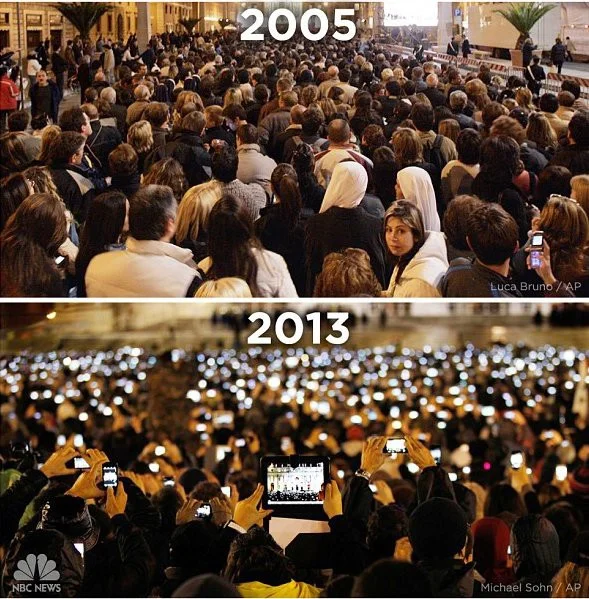
St. Peters Square in 2005 vs 2013.
My intention today is not to give a definitive answer to the questions I raised though. I am not sure there is one as this new technology is so new. More so my intent is to start the conversation about how this new technology will be treated. Why? Because I find all this incredibly new, interesting, and just plain old exciting. I can’t wait to see how live mobile streaming reaches its full potential.
Please let me know on Twitter, Periscope, or in the comments below if you know or hear of anything further. Looking forward to the discussion. Let’s start the conversation.

Perfecting Your One Sentence Pitch
As a startup founder, you will pitch your business thousands of times to potential customers, partners, team members, investors, and more.
As a startup founder, you will pitch your business thousands of times to potential customers, partners, team members, investors, and more.
When you pitch, you need to grab the listener's attention quickly, and communicate all of the core elements of your idea in a clear and concise manner. The goal is to get so good at pitching your business that could do your one sentence elevator pitch, in the short amount of time it takes to ride an elevator (perhaps with someone influential). In order to do this, I recommend using the simple Founder Institute one sentence pitch format described below.
Remember: If you can't describe your business in one sentence, then you don't understand it well enough.
The Founder Institute's Best One Sentence Pitch Format

Let's go through each of the items;
The "defined offering" needs to be short, simple and capable of being understood by everyone, like "a website," "a mobile application," "hardware," or "desktop software."
The "defined audience" is the initial group of people that you will market your offering to. In the case of consumer applications, it is usually a demographic, such as "women age 25 to 35 years old." In the case of business applications, it is usually a job function at a type of corporation, such as "system administrators at medium sized technology businesses."
Now that you have an offering helping an audience, you need to "solve a problem." The problem needs to be something that everyone understands, such as "reduce the time collecting bill payments" or "engage in an immersive entertainment experience."
The final component, the "secret sauce," adds your unique approach to solving the problem and demonstrates a mastery of the market. Some examples are "by sending automated email alerts based on analysis of highest response times" or "with virtual worlds constructed in reaction to the movements of the players."
Here are some more pointers; First, avoid using adjectives, particularly superlatives. Never say "first," "only," "huge" or "best," as these words signal inexperience. Second, properly define your target market. For example, "women" or "small businesses" are way too large and not nearly targeted enough. Third, eliminate any buzzwords, acronyms or industry jargon from your pitch. Finally, keep it short. It's easy to write a long sentence, but the right thing is to be concise.
In the short video below, Adeo Ressi, Founder & CEO of the Founder Institute, explains Startup Madlibs in full:

A Brief History Of Time, Before Apple Watch
Unlike other “A Brief History Of Time” stories I promise this one won’t include details of wormholes. I started following the wearables market a few years ago. In 2012 I had

Unlike other “A Brief History Of Time” stories I promise this one won’t include details of wormholes. I started following the wearables market a few years ago. In 2012 I had gained about 10 pounds due the abundant amount of pizza and chicken wings available in Buffalo, NY. Soon after I realized I needed to make a change. I knew I could simply tell my self to start eating better, but I also knew a physical step in the direction of a healthier lifestyle would increase my chances of shedding those pounds. So I put my money where my mouth was and I bought my first wearable: the Fitbit Tracker.

It was great. I gained access to information I never had before and began to use steps as a metric to gauge my days. I even used the food tracking part of the Fitbit app to monitor approximately how many calories I was consuming in a day. I loved my Fitbit then and I still have it now. I haven’t meet anything that could replace it yet. My phone does now have step data, however it’s just not as complete as the picture Fitbit currently gives me.
Then came the Google glass phase of my life. I had been tied to my smartphone since 2008 and wanted to finally be free. Google glass actually delivered on this front. The developers and designers of glass called this new wave: “Glanceable technology”. Software designed to get the user the information being delivered to them as fast and as efficiently as possible so the user could quickly resume what they were doing. This new wave of technology would force us to redefine all of our known metrics that currently focus on measuring time in app and user engagement. Unfortunately for Glass, Google underestimated how our primal brain uses faces throughout our daily lives and how unsettling putting a device on the face is to those looking at you. The camera on the front of the device didn’t help it’s case either.

Unlike how Google glass tested the wearable market with it’s own early prototype, Apple is about to do what it does best. Apple is best at using the user feedback from early versions of its competitors devices (in this case Android Wear watches, Google Glass, & Samsung Gear) to in its own time release a product that is 10x better than what the current market offers. They did this with the the Mac (RIP P.C.’s), the iPhone (RIP Palm), the iPad (RIP Netbooks), and are doing it again now with the Apple Watch.
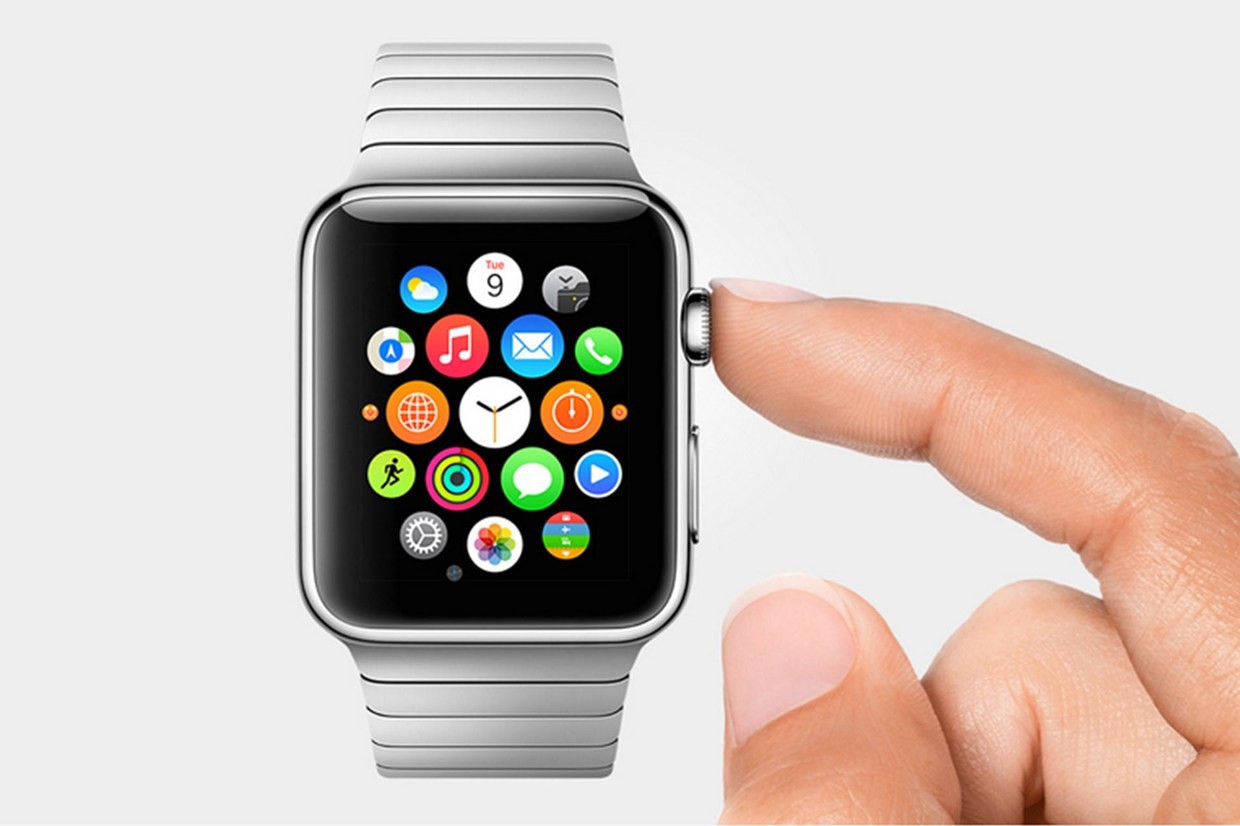
I think the form factor of a watch will deliver on the objectives Google Glass promised but couldn’t deliver in its form factor. Google evidently thinks this as well. It recently shut down the glass explorer program and as also ramped up its focus on Android Wear.
What I have wanted most though since owning wearables is feedback. We have been collecting all this data on ourselves for some time now. What do we do with it all? There is an opportunity to now be coached based on the data. This is where I think Apple could deliver where other wearables have fallen short.
Another interesting point is that the Apple Watch will be a new user interface. The first one since iOS. Apple already has a strong developer base and as we all know this is key to launching a new platform successfully. Assuming Apple makes it easy to develop for Watch we could be off the to the races again. Mobile already has established apps in its ecosystem. With the new hardware form factor and a fresh UI, the Apple Watch could re-open the Wild West of tech startups and also force us to find new metrics on how we evaluate a successful app.

Twitter Should Buy Meerkat
Something different happened yesterday. While I was on Twitter one of the people I follow, Matt Mazzeo @Mazzeo, sent out a tweet that said:

Something different happened yesterday. While I was on Twitter one of the people I follow, Matt Mazzeo @Mazzeo, sent out a tweet that said:
|LIVE NOW| Lowercase Office Hours - #meerkat http://t.co/ZmXJmDxw0h
— Matt Mazzeo (@Mazzeo) March 1, 2015I clicked on the link on my desktop browser. Nothing happened. I refreshed the browser. Nothing happened still. I looked up what Meerkat was and found out it was an app made by Life On Air, which was previously Yevvo. Giving up on the browser version I downloaded the app on my phone to satisfy my curiosity. There was only 2 people I follow on Twitter already on Meerkat. Then I clicked the link Matt Mazzeo had tweeted again, this time on my phones mobile Twitter app. It opened the link in the Meerkat app.
What I then saw was a casual conversation being had between Matt Mazzeo and his audience for office hours. He was responding to text chat questions from those viewing and really just giving helpful advice to everyone watching on Meerkat. It is important to note that while using Meerkat all the internal chats are actually also live tweets mentioning the broadcaster on Twitter simultaneously. There was only about 40 people in the room during the broadcast. One of them was Gary Vaynerchuk @garyvee.
The most interesting thing about this experience was that in real time and at a moments notice I went from sitting at my desk working, to seeing into someone else’s window across the country. There was no FaceTime or Skype dialing. No recording the video now and others will view it at a later time. There was an instant public connection to the world and all of ones Twitter followers. Using Meerkat this first time felt like I was seeing something I shouldn’t normally be seeing. This felt new!

After this stream ended then Ryan Hoover @rrhoover of Product Hunt got about 300 people on his live broadcast while he demonstrated new Product Hunt features. A few more hours went by. During that time notifications kept flashing on my phone as more and more people in my social network kept joining Meerkat.
One of the more interesting notifications I got was in the evening when Adam Lisagor @lonelysandwich went live from his living room saying “What is this thing? I think there might be a possibility I am streaming right now”. I myself did this by accident too when I was first playing with the app. It’s just that frictionless to go live to your Twitter followers.
When I woke up the next morning I got a Meerkat push notification again. This time telling me that@garyvee was live from New York, 1 minute ago. I clicked it and within seconds was inside Gary Vaynerchuk office, behind the scenes before the live recording of his “Ask Gary Vee” show.
I have to say that this experience feels new and exciting. Yesterday’s events and new users show that I’m not the only one that thinks so either. So back to the title of this post. All of this interaction on Meerkat is happening in real time and lives very much already inside of Twitter. It is the live broadcast video version of Twitter. No prerecorded delay. I could see these live events on Twitter cards as I scroll through my Twitter feed. Coming to life the same way video does on Vines as you scroll over them. Could you imagine what CNN or ESPN could do with this broadcast ability while covering live events. It is very early to tell if this app will survive long term and we certainly know this is not the first attempt at an app like this, but if I was twitter this is something I would not want to wait for Facebook or Google to acquire first. If there is anyone who know what happens when apps go viral at SXSW, coming up this month, it is Twitter.
Follow me on Twitter & Meerkat @TheSiskar

What A Birthday Taught Me
Today is my Birthday. However, the fact that today is my birthday is only the foundation here. The main point is that when I woke up
Today is my Birthday.
However, the fact that today is my birthday is only the foundation here. The main point is that when I woke up today I was excited. Before I spoke to anybody that day I took a deep breath and I felt confident in the day ahead of me. I could probably best describe this feeling as “Carpe Diem”. For my birthday I am not expecting anything extravagant. I don’t plan on receiving any lavish gifts. Still though, I feel excited. Energized. And I feel this way year after year.
I think most of us are hyper aware of our surroundings on special or unique days. Holidays are a good example. The have a similar special feeling. You know when you wake up this isn’t going to be an ordinary day. As you experience holidays the special feeling you have is shared among everyone celebrating the holiday that day. The interesting and unique thing about birthdays though is that you are the only one the day is about. There are multiple people involved in the celebration but at the end of the day your this day on the calendar solely belongs to you. That excited and energized feeling you get from the day is only inside you.
So I got to thinking and questioning myself. Why can’t everyday feel as unique as how I feel on my birthday. Why am I not giving everyday of my life the same sort of energy, excitement, and thrill?
I think it could possibly be that the level of reflection that one has on their life during their birthdays is somehow refreshing from other days of the year. A sort of mentally breaking the normal routine of life.
If simply labeling and viewing the day differently in our minds can break the routine of a normal day (while still having the same routine) and at the same time make life more exciting, then shouldn’t we be doing that everyday? Wouldn’t it be nice if everyday felt like we existed with as much purpose and excitement as we feel on birthdays?
I think I am going to give it a try. Carpe Diem.


The Day I Took The Headphones Off
As long as I can remember I have had headphones on my head. I think it started in middle school. Growing up in a house of 4 boys I would break out my “anti-skip” CD player almost every night to put on music while I did my homework.

As long as I can remember I have had headphones on my head. I think it started in middle school. Growing up in a house of 4 boys I would break out my “anti-skip” CD player almost every night to put on music while I did my homework. I would use music to drown out any loud noises or TV shows going on around me in the house. Listening to music has always allowed me to focus on what I was working on and what I needed to get done.
Once I got to college, now armed with a green iPod Nano, I still listened to music while doing work and while walking around campus sometimes. Then I discovered something else while on campus: Podcasts. I started listening to @Jason “This Week In Startups” almost every week along with other podcasts. This was a game changer for me. Now I wasn’t just learning from homework while listening to music, but I could learn while simply walking around campus or driving in my car.
Fast forward a few years and after college I moved to New York City. I had replaced my Honda Civic & iPod auxiliary cord for a metal subway train with a nice pair of earbuds. It seemed that almost everybody in New York City on their daily commute had headphones in their ears and a phone in their face. I felt right a home.
Around this time I started to look for more ways to optimize consuming information though sound. I realized I was really behind on all the books that were sitting on my shelf at home. This is when I found Audible. Depending on the book, normal commutes are usually long enough to get through most of a chapter on my way to work. In the first few months I finished “Hatching Twitter” by @nickbilton, “Physics of the Future” by@michiokaku, “David and Goliath” by Malcolm Gladwell, and many more. Right now I am in the middle of “How Google Works” by @ericschmidt and “The Innovators” by @WalterIsaacson. All great reads (or should I say listens) that I highly recommend.
So here we are after almost an entire lifetime of having a soundtrack or dialogue running during my life. Steve Jobs would have been proud. I grew up using music to block out world distractions in order to focus on what needed to at that time. It was and still is really effective for me. I used podcasts and audio books for years to ensure I was learning while doing even the simplest day to day tasks. Recently though I am starting to crave something different.
“I find myself wanting Seinfeld era New York City conversations.”

I find myself wanting Seinfeld era New York City conversations. I want mundane bus announcements. Listen to the street drummer as I walk by. Hear the Times Square hecklers calling out as I walk down the street. (Ok I’m just kidding about that last one. No one living in New York City wants to have to deal with walking through Times Square). The point is I love music, podcasts and books, but I want to learn from the world for a bit. I want to fully experience what the world and life in New York City has to offer me.
So today I took the headphones out. And look what happened. I created something. I created this. Yes, it’s not much, but it’s only day 1 with this revelation and it is some thing. Anytime you create anything at all in this world rather than simply consume it is a big deal.
Will I probably still use my headphones and music to focus and get things done when I need to? I think so, but moving forward I am definitely going to reconsider how and when I use my headphones while the world is happening around me.

3 Ideas to Land Your Next Job
With 2015 upon us and in full swing, everyone seems to be busy tying up loose ends, reflecting on 2014 and looking ahead to all of the great changes they'll be making this year. Thinking about how most of us spend the majority of our day working, if your job isn't something that you enjoy then there's really no better time to put that change at the top of your list.
Co-Authored by Joshua Siva, Co-Author of BOLD: Get Noticed, Get Hired
With 2015 upon us and in full swing, everyone seems to be busy tying up loose ends, reflecting on 2014 and looking ahead to all of the great changes they'll be making this year. Thinking about how most of us spend the majority of our day working, if your job isn't something that you enjoy then there's really no better time to put that change at the top of your list.
But let's be honest, over the past few years the job market has been a challenge for most, so here are a few fun, novel ideas that hopefully get the creative juices flowing so that you too can get noticed and ultimately get hired:
1. Attach Your Resume to a 6-Pack
Enter Brennan Gleason, the creative guy from Vancouver who answered two simple questions: what's something that people would like at the company I'm applying for, and how do I attach myself to that? Voila -- he decided to brew some homemade beer and print his resume on the 6-pack carrying container for his beer.
As expected, it was a huge hit that not only landed him the job but also gained Brennan a good amount of fame amongst the major media outlets. Beer is just one example, but it could be anything that you decide to attach your brand or credentials onto.
Check out the interview we did with Brennan:
2. Light Up Your House with Your Link
It's right around that time of year where your holiday lights may still be up or are freshly packed inside somewhere that you can quickly dig them out. Regardless, Liz Hickok was a seasoned corporate professional from Georgia who was looking for a new job. With her family's lights handy, she decided to post a little message on the front of her house that was sure to catch the attention of anyone driving by her heavily trafficked street.
Fast-forward a few days and in addition to the media coverage, she was landing interviews left and right which ultimately led to her next job. So whether it's a bunch of LEDs strung together, a billboard on the highway or even an ad in the local city flyer, be bold and put yourself out there.
3. Just Do the Job You Want
There may be no better way to prove you're the best person for the job you want than to actually go out there and just do the job. Avi Lichtschein did just that when he decided he wanted to work for the Silicon Valley startup and mobile payment processing company, Square.
When applying for the entry level sales role he wanted didn't work out, he decided to take matters into his own hands and literally go out to the street and prove he could generate interest in the Square service. After gaining a bit of traction, he forwarded the success back to the company, which was blown away by his initiative. Sure enough this got Avi noticed and hired. Heck, he took out the biggest risk in their hiring process by proving he was effective and could get the job done so it was a no-brainer for them to bring Avi on.
Whether you want to break into sales or another function within a company, try to find a way to prove you can do the job you've applied for and share your results. If you can actually do the job, you too should not only get hired, but should be able to hit the ground running on day 1!
These are just 3 interesting examples of how others got creative to stand out from the competition. You too can and should think outside the box even if it's something simple to give you an edge. And let's be honest, if nothing else, you'll be sure to get a really great dinner or interview story out of it just like the three stories above.

5 Ways to Interview and Network Better in 2015
Have you ever found yourself dreading the big interview or intimidating networking event? We've all been there - worried about what questions we'll get asked or whether we'll hit it off with whomever we speak with. But it doesn't and shouldn't have to be something to stress out over, especially when you're armed with a good story to tell.
Co-authored by Joshua Siva; co-author of BOLD: Get Noticed, Get Hired
Have you ever found yourself dreading the big interview or intimidating networking event? We've all been there - worried about what questions we'll get asked or whether we'll hit it off with whomever we speak with. But it doesn't and shouldn't have to be something to stress out over, especially when you're armed with a good story to tell.

Let's take a step back for a second and think about the types of people we enjoy spending time with. Usually there's something interesting about them and they keep our attention in one way or another. The job interview or the networking event is no different. Let's zoom in on the interview. Aside from the hard and soft professional skills a company may be looking to hire, they're also looking for someone who is interesting and is someone they can see themselves spending time with because let's face it, the majority of the day is spent working amongst colleagues and no one would prefer to work with someone they don't like. The same principles apply in all aspects of networking too.
With that said, here are 5 fun things you can do to interview and set yourself up to network better in the New Year:
1. Travel more and travel interesting
Pick a destination, plan something that takes you out of your comfort zone, and enjoy the experience. Consider getting "local" by renting a local house or apartment via Airbnb or get the scoop on what to do via TripAdvisor. Take lots of pictures, and try to maximize your trip by doing more than just sipping margaritas on a beach (although there's definitely a time and place for that too).
2. Learn a new skill and make it a habit
Never stop learning. Developing a new skill will not only make for a good story but also will keep your mind fresh, hungry, and curious to learn more. You can check out sites like Skillshare or Udemy to browse a vast array of skills to learn at your convenience and on your terms. It doesn't have to be professional either and could be more along the lines of learning to cook or speak a new language as an example. Just make sure you enjoy it!
3. Connect with someone new each month
In today's day and age where you're only as strong as your network, developing strong connections and continuing to build new ones is essential. Create a great LinkedIn profile and challenge yourself to reach out to someone new each month within your industry or at a company you might be interested in. If you're feeling brave (which you should be), try and set up a quick face to face coffee to add that human touch to your introduction.

4. Get active and stay fit
Your health is everything. Without it, you can't interview, network, or enjoy life's pleasures so don't under any circumstances sacrifice it for anything. It's the new year and everyone's trying to get into shape so why shouldn't you? Consider joining a workout class such as CrossFit or at a local gym. You'll feel better as a result and will hopefully portray a stronger image and make a better first impression wherever you go.
5. Create a side project that's visible to the world
It's never been easier to start a company or side-project with all of the tools and resources available to us via the Internet. Find a need, read James Altucher's"Ultimate Cheat Sheet to Starting and Running Your Own Business", and do something. Whether it remains a small time hobby such as selling your homemade soup at the local farmers market or turns into the next big thing, it'll force you to enhance your skill set and give you something interesting to talk about in any interview or networking setting. If you're still scratching your head about where to start, consider checking out Noah Kagan's list of resources, which has never steered me wrong.
With anything that may be a new experience, be sure not overwhelm yourself. To combat this and turn these new ideas into long-term habits, Stanford's behavioral guru BJ Fogg would suggest changing your environment and taking baby steps when starting out with any of the suggestions above.
Remember, there's no better day than today to start, so use 2015 as the year where you continue to develop yourself and your story. This is not only for your own well-being but also to ensure you're armed with an interesting story to tell to ace and take the stress out of any interview or networking event you attend.

The Incredible History of Buffalo, New York In 5 Minutes
43 North, the world's largest business idea competition, has released an awesome new video chronicling the amazing history of Buffalo NY.

43 North, the world's largest business idea competition, has released an awesome new video chronicling the amazing history of Buffalo, New York. The video titled "Next Things Now: Innovation & Entrepreneurship in Buffalo" summarizes all that Buffalo’s history has given to the world and as well as a hint of whats possible in the new era of One Buffalo. Check it out below:
Co-authored by The Herd Report