


The Founder Is the Continuum
We usually tell the story of entrepreneurship through the lens of companies: the idea, the product, the raise, the team, the exit.
But the deeper story is the founder’s journey.
A company is often just one chapter in a much longer learning curve.
After a decade of working with founder across multiple stages, I made this interactive timeline to map that journey more clearly: from seller to productizer, operator, architect, allocator, and steward. It is a way of looking at entrepreneurship not as a single startup event, but as the long work of turning labor into leverage, leverage into systems, systems into institutions, and institutions into something that outlasts you. And why as an investor, betting on the founder is the biggest leverage you can gain.


Everyone Is Going To Become An Engineer

For the last two years, almost every conversation about AI and work has started with the same question:
Are software engineers going away?
I think that is the wrong fear.
The more interesting possibility is almost the exact opposite.
Software engineering does not disappear. Instead, the engineering mindset spreads into every other computer-based job. Marketing becomes more like engineering. Sales becomes more like engineering. Customer support, finance, recruiting, operations, and strategy all start to become more technical, more automated, and more systems-driven.
The old version of these jobs was built around doing the work manually. Write the email. Pull the report. Update the spreadsheet. Respond to the ticket. Build the campaign. Copy information from one SaaS tool into another. Follow up with the customer. Chase the internal approval. Move the workflow forward by hand.
The new version is different. The job is no longer just to do the work. The job is to understand the work deeply enough to build the system that does the work.
That is the shift.
Stripe just showed us the new job description
The clearest signal I have seen so far came from Stripe.
Stripe opened a role called Forward Deployed AI Accelerator, Marketing. The title sounds a little abstract, but the job description is one of the most important AI labor market signals I have seen. Stripe says its marketing organization is undergoing a “fundamental transformation” and that it is building a team embedded directly with marketers to make AI the default mode of work, not an occasional tool.
That sentence matters.
Stripe is not hiring someone to make more marketing content. It is hiring someone to rebuild how marketing works.
The role embeds with roughly 20 marketers, studies their day-to-day workflows, identifies the highest-leverage work worth transforming, builds custom tools, agents, automations, and skills for each person, coaches the marketers toward self-sufficiency, documents the playbooks, and tracks progress against an AI maturity model.
That is the whole future of knowledge work hiding inside one job description.
It is one part marketer, because the person has to understand the actual work. It is one part AI engineer, because the person has to build agents, automations, workflows, and tools. It is one part consultant, because the person has to study messy human processes and turn them into repeatable systems. And it is one part coach, because the real outcome is not just a tool being built. The real outcome is the team learning to operate differently.
The requirements make the shift even clearer. Stripe wants someone with a hands-on track record building AI-powered tools, agents, automations, or workflows that changed real work processes. Not someone who merely uses AI as a chatbot. Someone who builds with it. The preferred stack includes Claude, Claude Code, Codex, custom agent frameworks, API integrations, and workflow automation tools.
The salary range is serious too. Stripe listed the US base salary range for the role between roughly $145,000 and $218,000. Business Insider separately reported another version of the role with a range up to about $198,000.
That is not an intern experimenting with prompts. That is a serious operating role at one of the most sophisticated technology companies in the world.
This will not stay in marketing
The reason this role matters is not because Stripe needs a better marketing operations person. The reason it matters is because every department has the same hidden structure underneath it.
Every function is full of repetitive workflows trapped inside inboxes, spreadsheets, SaaS tools, Slack threads, CRM fields, support queues, calendars, dashboards, and human memory. Most companies are held together by thousands of tiny manual handoffs that nobody has had the time, technical ability, or organizational permission to automate.
That is what AI changes.
Once this cohort + coach + build model works in marketing, the same job description gets copied into sales, customer support, finance, legal, recruiting, and operations. The surface area changes, but the pattern is the same. Embed with the people doing the work. Understand the workflows. Find the leverage. Build the tool. Coach the person. Turn the one-off solution into a reusable playbook.
Box is already showing another version of this pattern with its AI Business Automation Engineer role. That role is designed to embed with subject-matter experts across finance, legal, people, go-to-market, customer success, and other functions to identify business processes worth reinventing and rebuild them with an AI-first mindset.
The titles will vary. Forward Deployed AI Accelerator. AI Business Automation Engineer. Agent Operations Lead. Workflow Engineer. Internal AI Systems Builder. Function-specific AI Operator.
But the pattern will be the same.
The most valuable person in the department will be the person who understands the function deeply enough to automate it.
The org chart becomes a work chart
Microsoft’s Work Trend Index points in the same direction. Microsoft describes the rise of “Frontier Firms,” companies that organize around human-agent teams instead of only traditional job functions. It also says leaders are already considering new AI-specific roles like AI trainers, AI agent specialists, AI ROI analysts, and AI strategists across marketing, finance, customer support, and consulting.
That is the transition.
Companies are not deleting jobs. They are deleting the old shape of jobs.
The person who only does a single task becomes less valuable. The person who can turn a series of tasks into a system becomes more valuable. The person who waits for engineering to build them a better dashboard becomes less valuable. The person who can build the dashboard, wire the workflow, train the agent, measure the outcome, and teach the team becomes more valuable.
This is why “every person becomes an engineer” matters.
I do not mean every person needs to become a traditional backend engineer. I do not mean every marketer needs to understand distributed systems, memory management, or database internals. I mean every knowledge worker is going to need an engineering mindset.
They will need to understand the raw materials of modern work:
Workflows
Inputs and outputs
APIs and integrations
Data quality
Automation
Agents
Permissions
Failure states
Feedback loops
Measurement
Security
Human handoffs
That used to sound like engineering language. Now it is becoming operating language.
Coding is the leading indicator
Software development is not just another job category. It is where the future of computer work usually shows up first.
Developers are already learning how to manage agents, review AI-generated work, give feedback, debug outputs, orchestrate tools, and ship faster through human-machine collaboration. Anthropic’s research on Claude Code found much higher automation patterns in coding-agent usage than in normal chatbot usage. That should not be dismissed as a niche developer behavior. It is a preview.
The rest of the company is about to learn the same pattern.
The marketer becomes someone who can build a campaign machine. The support person becomes someone who can build an AI triage and response system. The salesperson becomes someone who can build a prospecting, enrichment, and follow-up engine. The finance operator becomes someone who can automate reporting, reconciliation, and variance analysis. The recruiter becomes someone who can build a sourcing and screening workflow.
The function does not disappear overnight.
But the old version of the function starts to look slow.
My prediction for the next two to three years
Over the next two to three years, I think we will see a clean split inside companies.
On one side will be people who use AI as a slightly better search box or writing assistant. They will prompt ChatGPT, copy the answer, paste it somewhere else, and keep doing most of their work the old way.
On the other side will be people who use AI as a systems layer. They will build small tools around themselves. They will connect agents to workflows. They will automate the annoying parts of their jobs. They will create reusable playbooks. They will teach their teammates how to operate differently. They will turn their own role into leverage.
That second group is going to compound.
They will not just be better at their jobs. They will redesign their jobs.
This is the real story hiding underneath all the noise about AI replacing workers. The future does not belong to people who merely use software. It belongs to people who can shape software around their work.
Every person is going to become an engineer, not because software development goes away, but because software keeps eating the rest of the org chart.

Deserts & Rainforests: If It Could Have, It Would Have.

There is a lazy belief floating around startups that often gets disguised as pattern recognition:
If this company could have broken out, it would have by now.
Once people decide a company is old, it stops being seen as early.
Not unfinished. Not still learning. Just old.
And from there, the whole environment changes. Investors lean back. They tell other investor friends to lean back. Talent gets hesitant. Partners stop caring. The company gets less patience, less help, less belief, and less shots on goal.
That is why this phrase is so dangerous. It does not just describe failure.
It helps cause it. It becomes a self fulfilling prophecy.
Having worked with startup ecosystem developers in over 150 cities around the world: you start to see a pattern that in certain startup ecosystems, this mentality is immensely more common… For emerging ecosystems it can really hold back growth.
Last month I got to have a great conversation with Ayhan Isaacs, Head of Economic Development at the Founder Institute and Paul O'Brien who spent over a decade in Silicon Valley, helped build the Founder Institute in Texas, and recently published the book Startup Ecosystems.
Deserts and Rainforests
If you walk through a desert and see sparse plant life, you do not conclude that life itself is weak. You conclude the environment is harsh.
Water is scarce. Nutrients are thin. Conditions are brutal.
In a rainforest, everything compounds. Moisture, density, biodiversity, feedback loops, mutual reinforcement.
Startup ecosystems are like that.
Some are growing in rainforests (Silicon Valley, New York City): patient capital, strong talent density, tight feedback loops, helpful investors, useful introductions, and a market that is ready.
Others are growing in deserts: thin networks, bad advice, premature pressure, scarce capital, weak distribution, and people on the outside mistaking temporary awkwardness for permanent incapacity. “If it could have, it would have…”
In a desert, even a healthy seed can look dead.
That is the mistake so many people make with startups.
They see slow growth in a harsh environment and diagnose the seed. When often the real issue is the habitat.
A lot of people are not evaluating startups through a pure value-creation lens. They are evaluating them through “status” logic. See more about, Status Games vs Wealth Games in my last post.
They are not really asking, what can this become? They are asking, shouldn’t the world have already validated this by now. That is how lazy dismissal gets mistaken for wisdom.
Main Street vs. High Growth
A lot of experienced business people, especially from Main Street SMBs, apply the wrong mental models to high-growth tech companies. That is not a knock on them. It is just a different game.
A stable small business is often optimizing around known demand of a product already well established in other markets, operational consistency, and efficient execution.
An early-stage startup is often still discovering and building the product from scratch. Perhaps even discovering a new market from scratch. Learning the user behavior, the messaging, the distribution motion, and the actual shape of the market.
That means a startup can look messy for a long time without being broken.
Trying to judge an unformed startup with mature small-business logic is like demanding rainforest output from something planted in sand.
Canva
Canva did not spring fully formed out of Silicon Valley.
Melanie Perkins and Cliff Obrecht started Fusion Books in Australia in 2007. That business became a proving ground for the broader idea. Bill Tai met them in Perth in 2010. He later helped connect them to Cameron Adams and Lars Rasmussen. Canva then raised its seed round in 2013 from a mix of Australian and U.S. investors. 6 years later after finding fertile ground.
From the outside, someone could look at that journey and say: if this was really going to be huge, why did it take so long?
But that would be the wrong diagnosis.
What looked slow was actually incubation.
What looked late was actually learning.
What looked geographically disadvantaged was a company proving itself outside the densest capital network in tech and then breaking through anyway.
That is the point.
Sometimes it is just a founder fighting through a thinner environment before the right network, capital, and timing finally click.
It is lazy to write founders off before rolling up your sleeves and helping. Every founder is on a journey.
Sometimes that journey happens across one company. Sometimes it happens across several.
Startups are as much human development systems as they are product experiments. The founding team is learning
judgment.
sales.
people.
markets.
Good investors understand this. They don’t gossip from the shadows.
They diagnose clearly. Offer tough love directly. They identify what is actually broken. They tell the truth. And then they roll up their sleeves to help. They coach. Help sharpen the positioning. Help with hiring. Open the right doors.
Good investors shorten the learning and feedback cycles.
That is what value-add is supposed to mean.
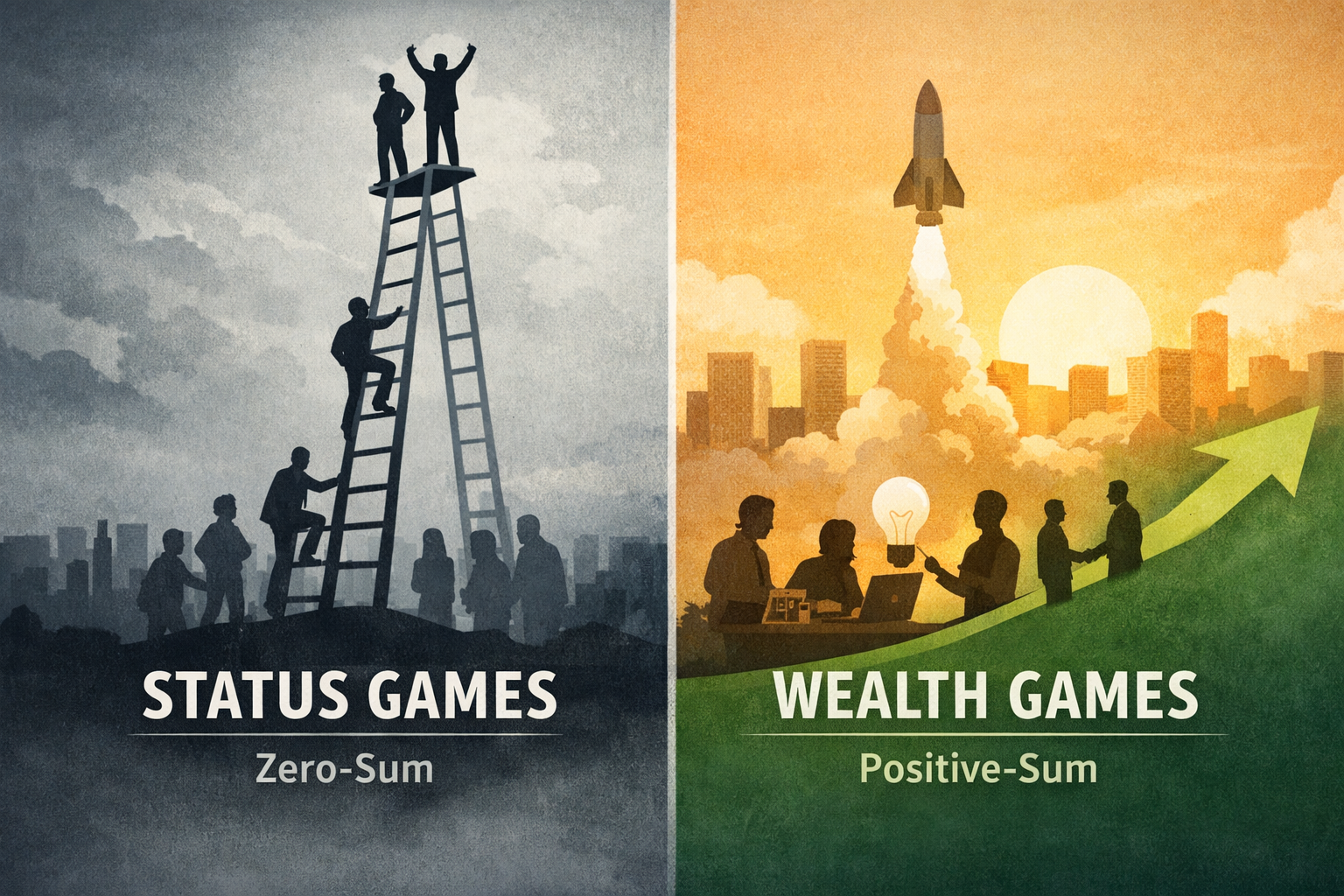
Status Games vs Wealth Games
Wether they realize it or not, everyone is playing a game.
Two people could be doing almost the exact same work: building, selling, hiring, raising; and yet they were playing completely different games.
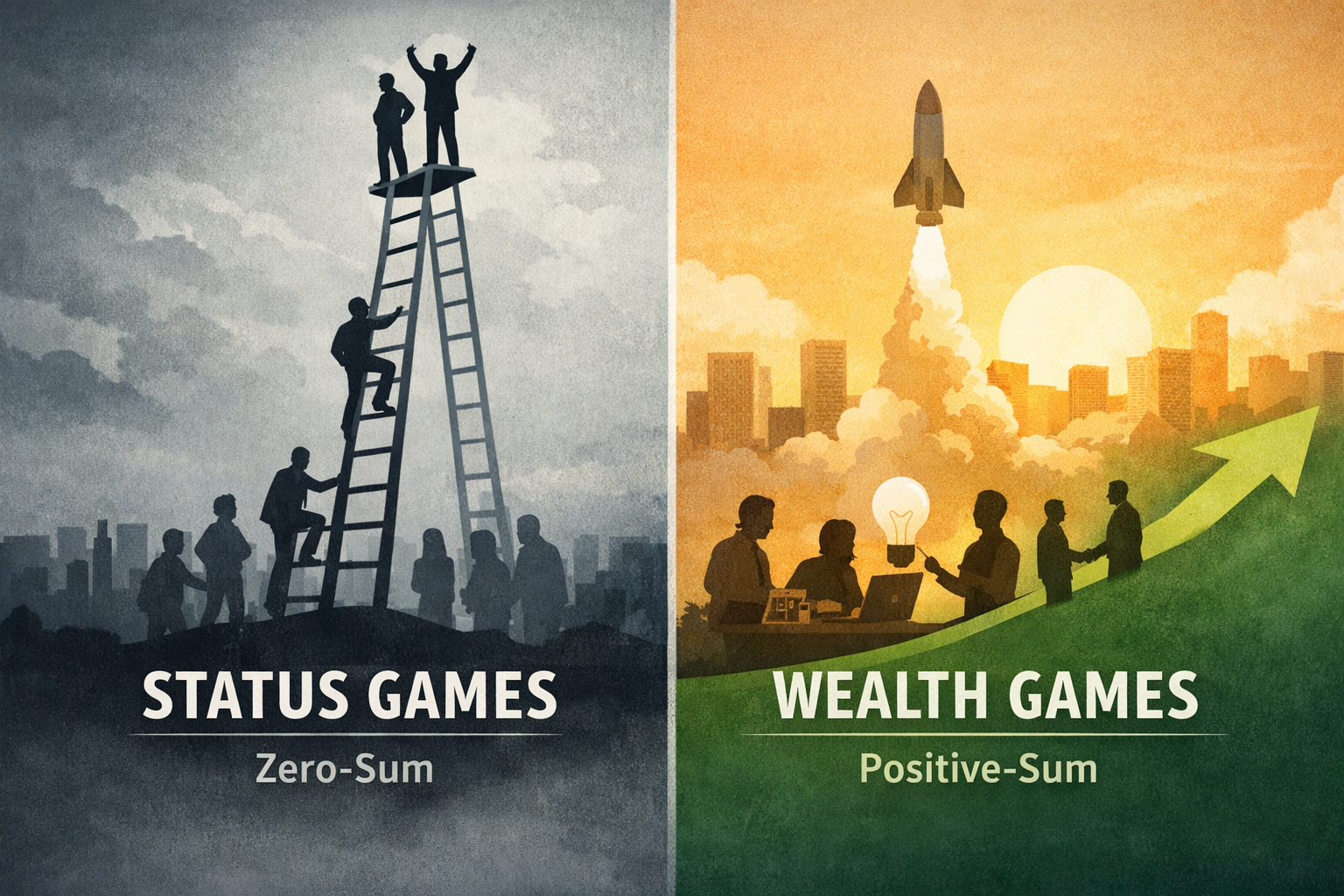
The Two Games
Naval Ravikant frames it simply: status games and wealth games. And the difference between the two is structural. These games operate on entirely different systems of incentives, feedback loops, and long-term outcomes.
1) Status Games
Status is about where you stand relative to others. It’s a ranking system with a fixed number of top spots. If someone moves up, someone else has to move down. That makes status games inherently zero-sum. They are a positioning system.
You see it everywhere once you start looking: titles, followers, institutional brands, and even subtle room dynamics like who gets listened to and who doesn’t. Status is NOT about absolute value creation. It’s all about perception, comparison, controlling the narrative, and positioning.
That also makes it unstable. Change the room and the hierarchy resets. Lose the signal and the status disappears. It’s rented, not owned.
2) Wealth Games
Wealth games are fundamentally different. Wealth comes from creating something that didn’t exist before: a product, a system, a workflow, or a network that other people find useful.
Wealth games are a value creation system. When that happens, the outcome expands instead of redistributes. Customers get value, builders capture revenue or equity, teams gain income and experience, and ecosystems compound. No one has to lose for you to win.
This is why technology matters so much. Software turns value creation into something that scales. One product can serve millions. One system can run continuously. One insight can be encoded and reused. Wealth compounds because value compounds.
When the Two Worlds Collide
This is the real tension.
A person playing a wealth game is usually asking questions like:
What can we build? How do we make this better? How do we create more value than existed before? How do we use technology, systems, and leverage to multiply output?
A person playing a status game is usually asking a different set of questions:
Who gets credit? Who has power? Who is above whom? Who is allowed in the room? Who controls the narrative?
Those incentives create friction.
The builder thinks progress should be meritocratic.
The status player thinks progress should preserve the hierarchy.
The builder wants efficiency.
The status player often benefits from friction, because friction protects incumbents.
The builder wants technology to flatten access.
The status player often wants scarcity, because scarcity preserves status.
So when these two people meet, they can be looking at the same company, the same product, the same market - and interpreting it through entirely different operating systems.
Old World Games vs New World Games
There is also a historical dimension here. Status and power games are older. They are rooted in aristocracy, institutions, court politics, gatekeeping, and fixed hierarchies. They come from a world where access was limited, information moved slowly, and your position in the system mattered more than your ability to build outside of it.
Wealth games, at least in their modern form, are more closely tied to technology. Technology lowers barriers, expands markets, compresses distribution, and gives individuals leverage that used to belong only to institutions. Unlimited access to information via the internet, a laptop, a codebase, an audience, a payment rail, an AI system; these are all tools that let a single person create outsized value.
That is why the modern technology era feels so disruptive. It does not just create new products, but it redistributes power away from old status structures and toward builders who can create, ship, and scale.
The Trap for Builders
The trap is that builders often underestimate how much old world logic still governs new world systems. You can build with modern tools and still have to navigate old institutional power dynamics. You can create real value and still run into gatekeepers who are optimizing for their own status preservation. You can naively think you are in a wealth game and suddenly realize the room you walked into is scoring something else entirely.
This is why founders often get frustrated. A founder thinks they are building a company. An investor may be evaluating social proof. A customer may be evaluating utility. A journalist may be evaluating narrative. A competitor may be evaluating positioning. Everyone is looking at the same thing, but not everyone is scoring it the same way. That is why startups & feedback can feel confusing from the inside. And why the best founders develop a strong instinct and muscle around how to best digest feedback.
That does not mean value creation stops mattering. It means the world is layered. Some ecosystems reward truth. Some reward signaling. Some reward actual output. Some reward affiliation.
Part of maturity is learning to tell the difference. So now we live in a strange hybrid system: technologically modern, psychologically ancient.
The naive response is to ignore status completely.
The corrupt response is to worship it.
Neither is right.
The Higher Order Move
The better move is to understand both games clearly, but build your life around the right one.
You need enough awareness of status to navigate the world as it actually is. You need to recognize power structures, incentives, gatekeepers, and social dynamics. You need to know when a room is evaluating truth and when it is evaluating hierarchy.
But you do not want to become trapped inside that logic. Because status does not compound the way value does. And let’s be honest, who wants to get to the top by only tearing down those around them.
Technology does compound. Ownership does. Systems do. Networks do. Products do.
The long arc still bends toward builders, because builders create the new surplus that the rest of society eventually reorganizes around.
That is why the right long-term strategy is not to become blind to status, but to understand it and to subordinate it to wealth creation. Use status when it is useful. Read power accurately. But keep building engines.
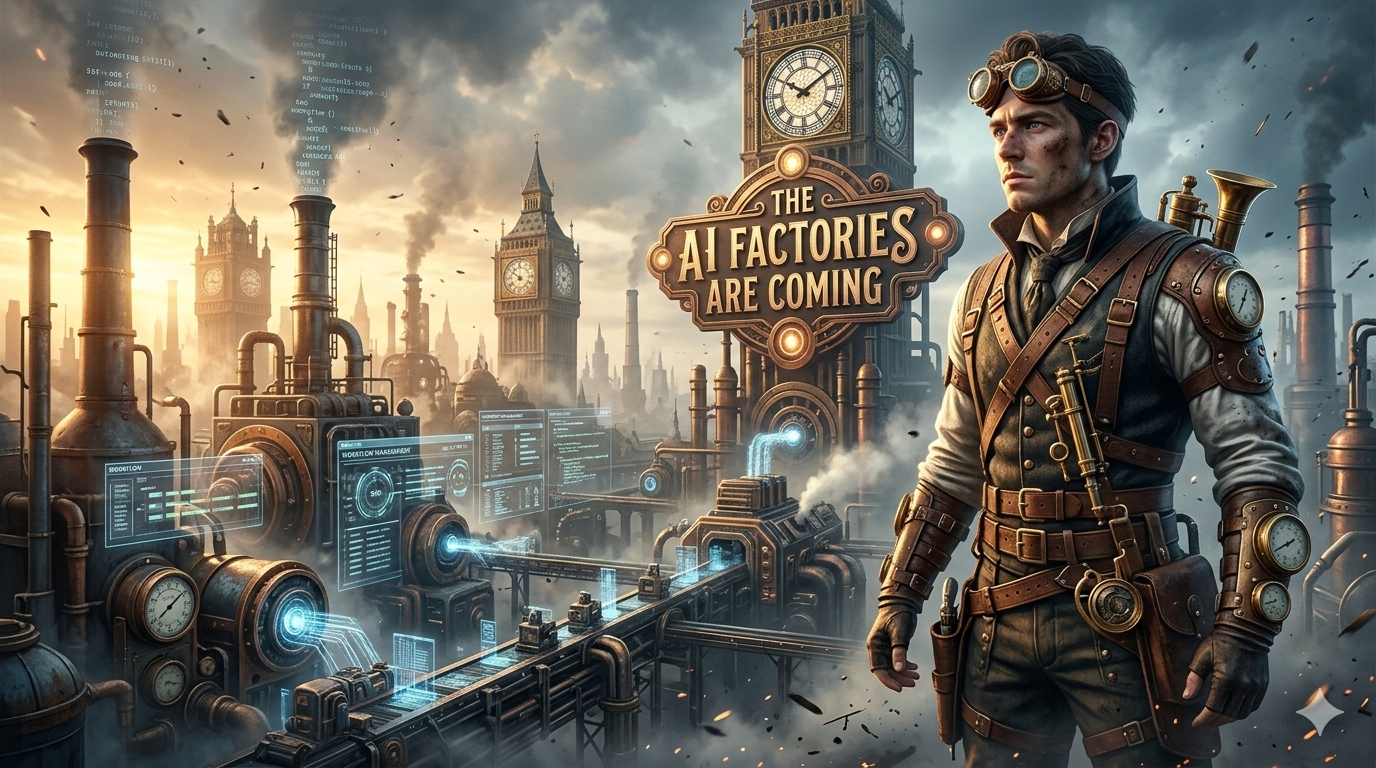
A.I. Factories Are Coming
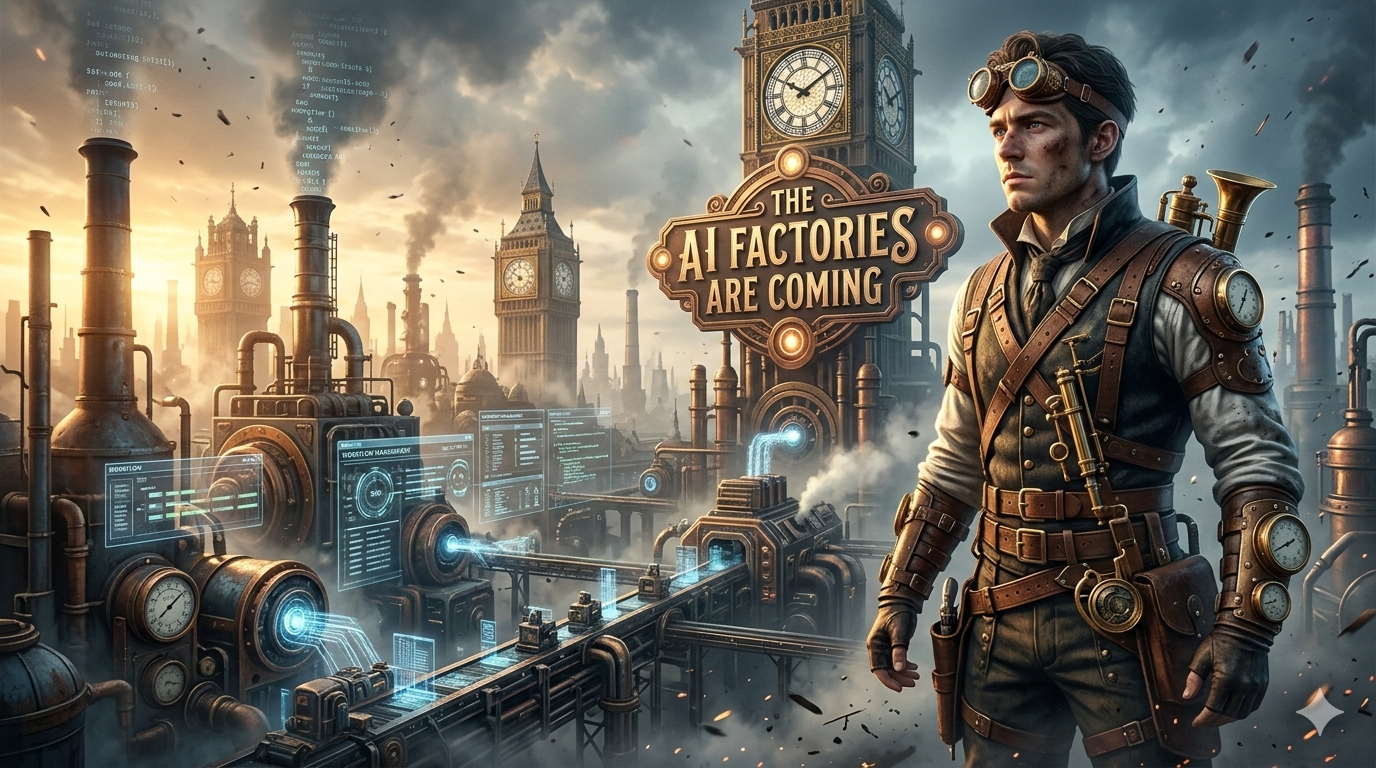
Machines specialized to the factory floor; I think software will specialize to the workflow floor.
For most of the last 40 years, software has felt like this:
A company buys apps.
People learn the UI.
Work bends to the software.
But I think AI flips the relationship. We are entering an era where software needs to bends to the work. And this is possible for the very first time thanks to an AI models ability to “reason”.
Not because “anyone can code” (though that is suddenly closer to true than it has ever been), but because the cost of turning intent into working software is collapsing. And this is not the first time this has happened.
The Industrial Revolution did the same thing for turning raw materials into physical goods. In both revolutions, the headline is not “things got cheaper.” The real story is who gets to build, what becomes commoditized, where value migrates, and which layers become defensible.
The Signal
Last year Klarna, a public fintech company, publicly said they stopped using Salesforce internally because they built their own in-house version. And the internet translated that into “AI replaced SaaS.” The more accurate read, based on the CEO’s clarifications, is that Klarna consolidated a sprawling software stack into a unified internal knowledge and workflow layer. The point is not that Klarna “swapped Salesforce for a chatbot.” The point is that AI made it economically rational to internally build company specific systems that used to be too expensive to justify building and maintaining.
A similar signal is showing up in workforce decisions. Jack Dorsey’s Block announced layoffs recently while explicitly framing “intelligence tools” as part of the productivity equation. Whether you agree with the decision or not, the posture matters: leadership teams are starting to treat AI productivity as an operational lever.
If you are a software buyer, this changes your default question from “Which tool should we buy?” to “Should we buy this at all, or should we build an internal version that matches our workflows?”. So this got me to thinking. When has this happened before in human history. When did rapid improvements in automation completely change how companies operate internally.
The Industrial Revolution
Taking off in the late 1700’s, the factory was not just a building with machines. It was a new way to build a company.
Standardized parts, repeatable processes, quality control, floor supervisors, supply chains, and distribution all mattered as much as the machines themselves. The big unlock was the ability to chain machines into a reliable production line, and then continuously improve the line.
Once that happened, two shifts followed quickly:
First, production became less about individual craft and more about overall system design and operations across the whole factory.
Second, value moved toward the layers that scaled: distribution, logistics, financing, brand, and the ability to run a high quality, high uptime operation.
The AI Revolution
Modern companies do not run on machines. They run on workflows.
Sales is a workflow. Support is a workflow. Hiring is a workflow. Fundraising is a workflow. Most “software” is really a set of screens trying to corral messy human reality into a predictable sequence of buttons to add new data, and dashboards to display existing saved data.
AI changes the unit economics of that sequence. Instead of forcing work through rigid screens, you can express intent and constraints, and the system can generate the next step: the outreach, the doc, the follow up, the analysis, the handoff. Over time, that behavior can adapt to how your business actually operates.
This is the key tension that will define the next decade.
Agents are the new machines.
The winner won’t be the tool with the prettiest UI. The winner is the system that adapts to the workflow and remains governable. An AI factory of agents taking inputs and producing outputs. Where software engineers are the new floor supervisors, guiding the agents to keep the production line moving.
What Tools Survive In This New World?
When software becomes cheaper to create, survivability depends on what layer the tool truly owns.
A simple map helps:
Systems of record (truth): saved data, audit logs, access permissions, compliance.
Systems of internal coordination: chat, tasks, approvals, shared knowledge.
Systems of external distribution: the default place work begins (inbox, browser, operating system).
Systems of action: automation and execution across tools.
Tools that are mostly “UI around a database” are the most exposed. Tools that own truth, governance, integrations, distribution, or network effects have much stronger survival odds.
Take GitHub for example. Even if AI changes how code is written, GitHub is not just a UI for codebase repositories. It is an ecosystem with deep integration surface area, security and governance expectations, and a workflow standard for teams. That is hard to reproduce in a way that users trust.
Generic CRMs like Salesforce are perhaps more nuanced. The UI layer is vulnerable because dashboards and data entry are cheap to rebuild. The sticky parts are the relationship identity graph, governance, event streams, integrations, and the organizational truth that accrues over time. Many companies will build internal workflow layers on top of CRM backends, and the large CRMs will survive by becoming substrates, or an underlying layers that are ready for agents to plug into them.
Slack has a similar split. Basic messaging UI is easy to recreate. What is not easy is becoming the default coordination hub with the integration fabric, enterprise controls, and institutional memory that teams rely on. AI also shifts the interaction model: less “talking in channels,” more talking to an agent that uses channels.
Intercom and other customer support platforms are heading toward a focus on outcome competition. Intercom now charges per successful interaction it’s AI Agent Fin has with a support ticket. If Fin can resolve the support ticket without a human, it gets paid.
Defensibility & The New Shape of Software
This is where a lot of people overcorrect. Software does not “die”. A large category of software becomes the underlying layer below agents. What dies is the assumption that shipping just a UI is defensible.
The winning shape of SaaS in the AI era looks like this:
Systems of record truth + agentic action + policy controls + pricing tied to outcomes
In plain language: fewer rigid screens, more reliable backends and fluid orchestration of workflows, with strong governance to ensure any autonomous behavior is safe.
To evaluate defensibility of a business, do not ask “Could we build the UI?”. Instead ask “Could we reproduce the hidden factory behind the UI?”
Here is a practical rubric you can use with any tool.
Rebuild Difficulty Index (RDI)
Score each 1 to 5 (low to high). Add them up.
Data model gravity: complexity of schema, relationships, and historical truth.
Edge case depth: how many messy scenarios are baked into the product.
Integration surface area: APIs, webhooks, identity providers, upstream and downstream systems.
Governance and compliance burden: audit, retention, permissions, regulatory requirements.
Reliability requirements: uptime expectations, incident response, SLOs, on call burden.
Distribution and network effects: ecosystems, standards, marketplaces, “default hub” behavior.
How to read the score:
12 or below: easy to rebuild (danger zone for niche UI SaaS)
13 to 19: rebuildable, but only if it compounds your advantage
20 to 26: hard to rebuild (platform territory)
27 to 30: you are not rebuilding this unless it is your core business
The most common mistake is underestimating governance and reliability as those are the costs you do not see on a product demo.
To Build or Buy Software?
In the AI era, every software purchase competes with a new alternative: “We could build the version we actually want.”
Buyers will increasingly run a simple, implicit calculation:
How fast do we get real value?
How painful is onboarding?
How disruptive is workflow change?
What is the cost and risk of building?
What is the out of the box value vs total cost to build? A useful way to think about “value out of the box” is not features. It is time to outcome. If a tool you buy takes 90 days to implement, requires major training, and produces unclear value until adoption reaches critical mass, teams will start asking why they are paying at all. Onboarding and disruption include admin time, training hours multiplied by real salaries, migration pain, and the opportunity cost of slowed execution. If the ratio is not obviously positive, the default flips toward building something smaller that works now.
When Building Is Synergistic?

Building is a competitive advantage when it compounds.
It tends to be synergistic when:
The workflow is revenue critical and repeated daily.
Your workflow is meaningfully unique, or uniquely excellent.
The system captures compounding data about what works.
The build sits at a leverage point that orchestrates multiple tools.
You can keep the surface area narrow at the start.
The best internal tools begin as one workflow loop, not a full replacement for a platform.
When Building Is A Distraction
Building can also become a trap though, when you accidentally start a software company inside your existing company. It is usually a distraction when:
The job is already a commodity or compliance heavy (payroll, accounting)
The scope expands into an infinite roadmap you then have to build (and maintain).
There is no clear operator owner with metrics and prioritization authority.
Reliability requirements force you into platform mode (24/7 uptime, audits, user permissions, security reviews, etc).
The clean strategy that wins most often is hybrid:
Buy the backbone. Build the nervous system.
Buy systems of record where truth must be maintained. Build the adaptive workflow layer that turns truths into action for your customer.
What To Do Next
If you are a founder or CEO, you can act on this without a massive re-platform. Start by treating your company like a production line, not a collection of features. In the Industrial Revolution, breakout fortunes did not come from owning a single machine. They came from designing the full system and running it better than everyone else.
Andrew Carnegie built a steel empire by industrializing production and integration. He ultimately sold Carnegie Steel in 1901 for $480 million, and the U.S. Steel merger that followed was capitalized at roughly $1.4 billion, often cited as the first billion-dollar corporation. John D. Rockefeller built Standard Oil into a dominant refining operation, controlling roughly 90 to 95 percent of U.S. refining by 1880. These were not “tool decisions.” They were operational systems that turned new technology into repeatable, scalable output.
AI sets up a similar game, but the production line is digital this time. McKinsey estimates generative AI could add $2.6 to $4.4 trillion in annual economic value across use cases. That scale is why this moment feels like a new boom. A huge amount of work is about to be retooled.

Aictory = A.I. Factory
The companies that build reliable “workflow factories” will compound speed, quality, and learning.
The Industrial Revolution lesson is still the right ending: the advantage did not belong to the people who admired machines. It belonged to the people who designed and ran the factory.
The AI era will reward the teams that can design and run the workflow factories.
Welcome to the age of the Aictory.
NOTES & RESEARCH:
AI and the software stack shift:
Klarna CEO clarifying the Salesforce story (and the nuance behind it):
https://techcrunch.com/2025/03/04/klarna-ceo-doubts-that-other-companies-will-replace-salesforce-with-ai/
https://diginomica.com/those-shutting-down-salesforce-and-workday-rumors-klarna-no-we-didnt-replace-saas-llm-admits-ceo
https://www.itpro.com/technology/artificial-intelligence/klarna-ceo-sebastian-siemiatkowski-salesforce
Klarna CEO post: https://x.com/klarnaseb/status/1896698293759230429
Block layoffs and the explicit AI narrative:
https://apnews.com/article/18e00a0b278977b0a87893f55e3db7bb
https://www.theguardian.com/technology/2026/feb/27/block-ai-layoffs-jack-dorsey
Generative AI macro value estimates (McKinsey):
https://www.mckinsey.com/capabilities/tech-and-ai/our-insights/the-economic-potential-of-generative-ai-the-next-productivity-frontier
Industrial Revolution parallels:
Carnegie’s 1901 sale of Carnegie Steel:
https://www.carnegie.org/interactives/foundersstory
U.S. Steel’s founding and capitalization:
https://www.library.hbs.edu/special-collections-and-archives/exhibits/us-steel/the-founding-of-us-steel-and-the-power-of-public-opinion
Standard Oil’s refining dominance by 1880:
https://www.britannica.com/money/Standard-Oil
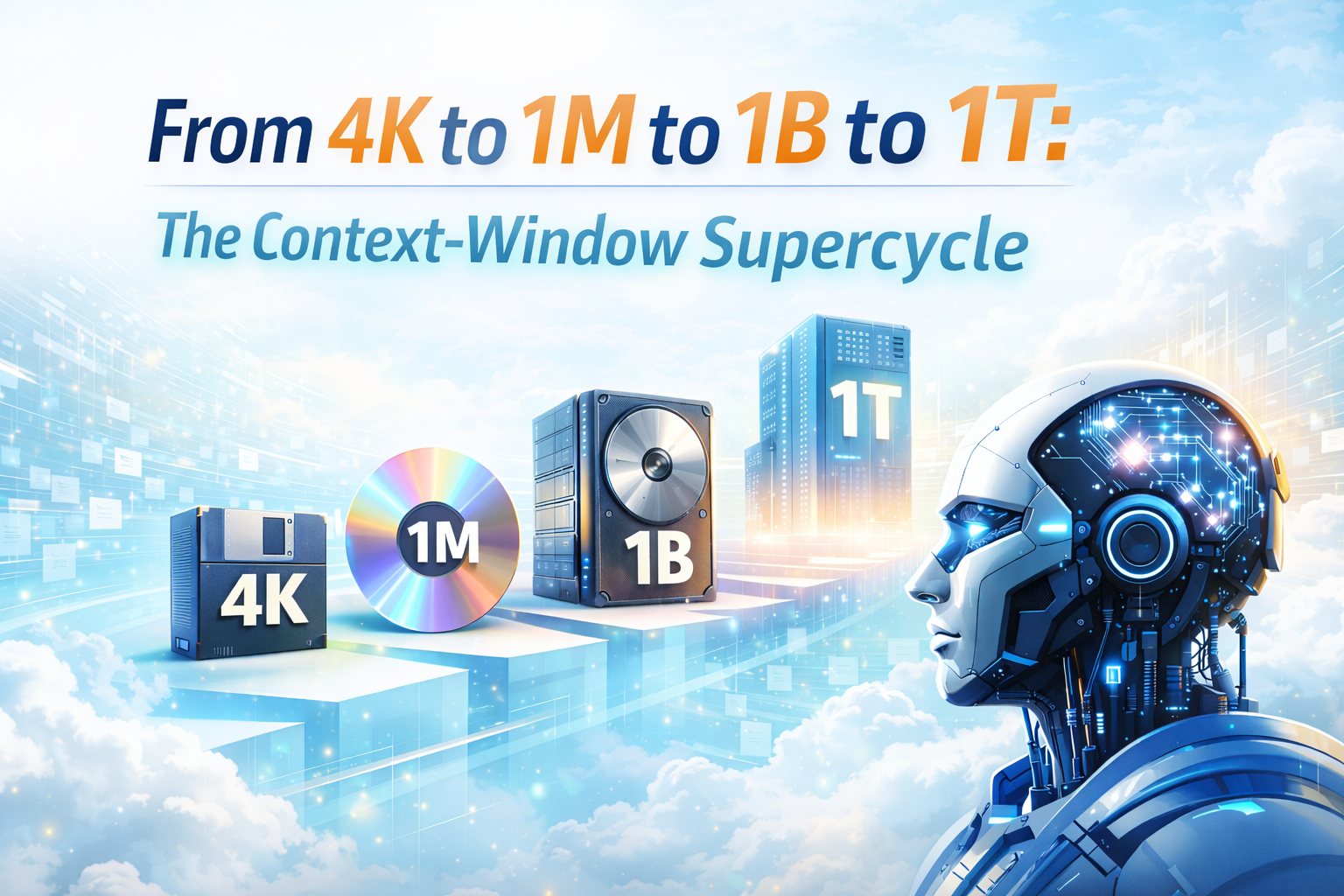
The 1 Trillion Token Context Window
From 4K to 1M to 1B to 1T:
If you want to understand where AI is going, let’s stop staring at “IQ” benchmarks for a minute and look at memory.
An A.I. model’s context window is its working memory: how much information it can hold in mind at once while reasoning. It’s measured in tokens (roughly word chunks, though tokenization varies by language and content).
When context windows expand, the category of software expands. This is the same pattern we lived through in the PC era when RAM and storage went from kilobytes to megabytes to gigabytes to terabytes to petabytes. Bigger memory didn’t just make the old apps faster, it created entirely new apps.
We’re watching that happen again, except this time the “app” is “intelligence”.
What The Hell Is A Context Window?
A context window isn’t hard drive “storage.” It’s closer to a computer’s RAM.
When you send a prompt, the system tokenizes it (breaks text into token units like below), then a transformer model (more on that here), processes the full sequence to predict the next token.
Under the hood, transformers use self-attention: each token can look at (attend to) other tokens to decide what matters for the next step. During generation, the model keeps a running internal cache of what it has already computed for prior tokens (often called the KV cache, because it stores “keys” and “values” for attention).
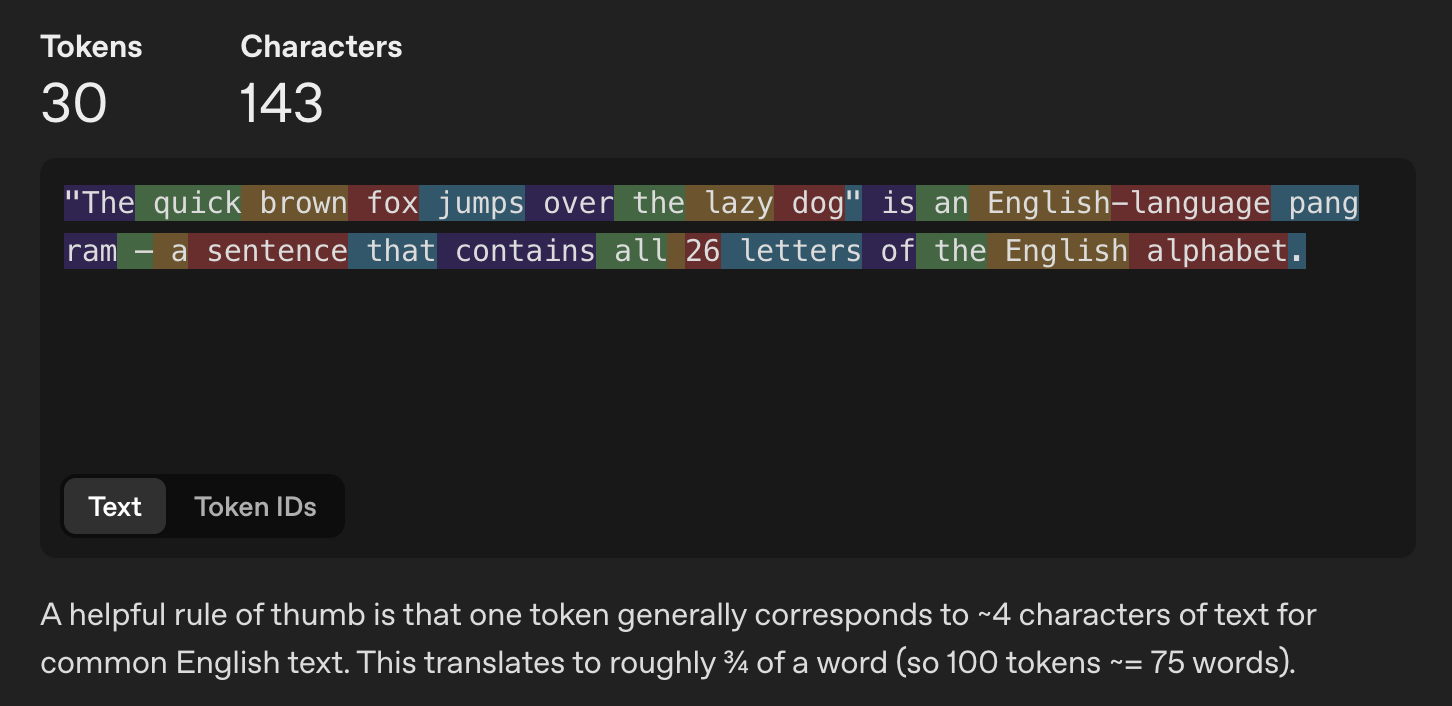
That cache grows with every additional token. So longer context is expensive in two ways:
Memory (VRAM/RAM): the KV cache scales roughly with context length × layers × hidden size.
Compute/time: attention and related operations get heavier as the sequence gets longer, even with modern optimizations.
How model size (parameters) relates to context length
Model parameters are the fixed weights (the “brain size”). They don’t automatically give you a bigger context window. A smaller model can be built with a huge context window, and a massive model can ship with a smaller one.
But model size heavily affects the cost of long context:
Bigger models typically have more layers and larger hidden dimensions, so each token consumes more KV cache memory.
That means at a given hardware budget, there’s a tradeoff: bigger model or longer context (unless you scale hardware or distribute inference).
Bigger models often do better at long-context reasoning if they were trained for it—they’re better at “needle in a haystack” retrieval, and they can maintain coherence across more material.
How and why newer models get bigger context windows
Vendors have been pushing context limits upward because three things improved at once:
Training methods: models are increasingly trained or fine-tuned on longer sequences so they don’t fall apart when you hand them book-scale inputs.
Position handling: transformers need a way to represent “where” a token sits in a sequence (positional encoding). Newer approaches (and extensions to existing ones, like scaling/adjusting rotary position methods) make it more reliable to generalize beyond the lengths seen early in training.
Systems engineering: better attention kernels (faster GPU implementations), smarter caching, chunking, and memory hierarchies make long context economically viable.
The key idea: “a 1M context model” is rarely doing one naive, quadratic attention pass over a million tokens like it’s 2017. It’s typically a stack of innovations—efficient attention, caching, longer-sequence training, and increasingly hierarchical memory (hot/warm/cold) so the system can reach a massive corpus without needing every byte in the active window at once.
Where Context Windows Started in 2022
In 2022, the mainstream experience was a few thousand tokens.
The GPT‑3.5 model that powered the launch of ChatGPT is commonly cited at 4,096 tokens of context. On the order of a handful of pages, not a library.
That shaped how we used AI:
short prompts
short conversations
“paste a paragraph, get an answer”
summaries and rewrites
small snippets of code
You could feel the ceiling. The model wasn’t “forgetting” because it was lazy. It was forgetting because it literally couldn’t keep the whole thread in memory.
That limitation is why RAG (retrieval‑augmented generation) and vector search exploded.
For a couple years, the “correct” architecture looked like this: keep your knowledge outside the model (docs, wikis, tickets, policies, code), embed it into a vector database, retrieve the top‑K chunks relevant to the user’s question, then inject those chunks into the prompt so the model could answer as if it had the memory. It is a clever workaround for tiny context windows and it helped ground answers in source material.
But then something happened: One million‑token context windows showed up in real products. Suddenly, for many internal use cases, you can skip brittle chunking and retrieval and just drop the whole handbook (or a big slice of the repo, looking at you Cursor) into the prompt . RAG doesn’t disappear as it’s still essential for freshness, access control, and anything truly massive. But long context turns it from “mandatory plumbing” into “an optimization lever.”
Where Are We Now in Early 2026
Today, long context is real — and it’s arriving in layers, with each of the leading companies shipping models that have larger context windows.
OpenAI GPT-4.1: 1,047,576 tokens of context.
Anthropic Claude Opus 4.6: 1M token context window in beta.
Google Gemini 3: A 1 million-token context window.
To make that scale visceral: a 1M window can fit book-scale inputs in a single request. This is a phase change.
The PC Analogy
In the 2000s, memory growth created a ladder:
KB → MB: basic documents, simple apps, floppy discs
MB → GB: browsers, rich media, “do everything” desktop software, CD ROM’s
GB → TB: personal photo and video libraries, local archives, USB flash drives, external hard drives, search over your stuff
TB → PB: data warehouses, analytics, machine learning pipelines

AI context windows are climbing the same ladder:
4K tokens (2022): “single document” intelligence
128K to 200K: “small library” intelligence
1M to 2M: “department, codebase, case file” intelligence
10M+ (research direction): “organization” intelligence
1B (the next horizon): “enterprise memory” intelligence
1T (the thought experiment): “civilization‑scale” intelligence?
Bigger context won’t just make the same chatbot better. It unlocks new kinds of software.
What Becomes Possible As Context Grows
1) Whole‑artifact reasoning replaces snippet reasoning
With small context, AI is a smart autocomplete that you constantly feed.
With million‑token context, AI can take in:
a meaningful chunk of a codebase
a full contract set for a deal
a complete customer history
meeting transcripts plus emails plus docs behind a project
The difference is coherence. The model stops inventing structure because it can actually see structure.
2) The model becomes a system, not a chat
Bigger context windows are the foundation for agents that can plan multi‑step work without losing the plot. When the agent can keep the goal, constraints, prior attempts, and the source materials all in memory, it stops thrashing.
This is when AI stops feeling like a conversation and starts feeling like an operating system.
3) In‑context learning becomes practical
When you can fit a full playbook inside the prompt (SOPs, examples, edge cases), the model can learn how your organization works on the fly without fine‑tuning.
4) Search and analytics collapse into one interface
At small context, you search for info, then ask the model.
At huge context, the model can consume the corpus and answer with comparisons and cross‑document reasoning in one go. This is why long context is a direct threat to the traditional “search box → ten blue search result links → manual synthesis” workflow.
5) Personal and organizational memory becomes real (and controversial)
A million tokens is enough for “a lot of you,” but not “all of you.”
A billion tokens is where the idea of durable, high‑fidelity personal and company memory starts to feel inevitable.
A trillion tokens is where it gets existential.
The Billion‑Token Era
A billion tokens is not a slightly bigger prompt. It’s a different class of system.
The closest biological analogy in this era is the human brain. We have ~86B neurons and on the order of ~100T synapses. But the real lesson isn’t raw “storage”; it’s actually architecture. Humans have a tight working-memory bottleneck (a few chunks), yet we feel limitless because we retrieve the right memory at the right moment.
That’s the same direction AI is moving: a compact reasoning engine paired with huge reachable memory and tool access. In that world, “context window” stops meaning “one giant prompt” and starts meaning “how much of reality the system can reliably bring into the room at the right time.”
Think about what fits inside “enterprise memory”:
Years of email and meeting transcripts
Slack and Teams history
Whole CRM, ticketing, and support logs
Contracts, policies, and internal wikis
Code, specs, PRDs, incidents, and postmortems
Every customer call summary and renewal thread
At this scale, the model can stop being a tool you consult and start being a brain you run.
What Software Looks Like at 1B Tokens:
1) The company gets a living institutional memory.
Not a wiki. Not a search engine. A memory that can answer questions like:
“When have we tried this before and why did it fail?”
“Which customers asked for this, and what did we promise them?”
“What security exceptions did we grant, and what was the rationale?”
2) Compliance becomes continuous.
Instead of preparing for audits, the system is always checking.
It can track policy drift, flag risky language, surface missing approvals, and maintain provenance for why decisions were made.
3) Strategy becomes simulation.
When you can load the company’s full history, you can run counterfactuals.
“What if we raised pricing last year?” “What if we restructured the funnel?” “What if we fired that product line earlier?”
These won’t be perfect forecasts, but they will be grounded in far more evidence than a human can hold in mind at one time.
4) The agent stops being a worker and becomes a manager.
With enough memory, an agent can coordinate other agents with stable direction. It can maintain long‑running objectives across months of work without constantly being re‑trained by human reminders.
What This Does To Work
At 1B tokens, the definition of “knowledge work” shifts. The bottleneck moves from information retrieval to judgment, taste, ethics, and relationships.
The winning teams won’t be the ones who “use AI.” They’ll be the ones who build the cleanest, most consentful memory for AI to run on.
The Trillion Token Horizon
Sam Altman has described a kind of north‑star architecture for AI: a relatively compact reasoning engine paired with extreme memory and effectively unlimited tool access.
“It can run ridiculously fast and 1 trillion tokens of context and access to every tool you can possibly imagine.”
- Sam Altman
This framing matters because it flips the obsession from stuffing the model with knowledge to building systems that can think, remember, and reach.
1T tokens of context become the working set for identity, history, constraints, and long‑range coherence.
Unlimited tool access becomes the bridge to the real world: search, databases, code execution, simulations, CRMs, inboxes, payments, and other agents.
The model itself becomes the reasoning engine orchestrating memory and tools, not the place where everything lives.
A trillion tokens is where the scope moves beyond a single enterprise. A trillion‑token system could plausibly reason across:
An industry’s contracts, norms, and market structure
Entire ecosystems of company interactions
Multi‑institution deal networks
Massive multimodal archives (text, audio, video, code)
This is the “civilization graph” direction: not just remembering your company, but understanding the web of incentives and history around it.
What software Looks Like At 1T Tokens:
1) Cross‑organization intelligence becomes normal.
Today, every org reinvents the wheel because its memory is locked inside its own tools.
At 1T scale, you get systems that can map patterns across thousands of organizations, not as a static report, but as a reasoning engine.
2) Deals become computed.
For high‑stakes workflows like fundraising, partnerships, M&A, procurement, hiring, and public grants, the limiting factor is usually context.
A trillion tokens means the agent can carry the full history: people, incentives, prior negotiations, market comps, and every clause ever argued.
That changes negotiation itself. Not because it “wins,” but because it stops missing obvious things.
3) Education flips from content to guided cognition.
If a system can keep the full canon plus your learning history in memory, education becomes adaptive reasoning rather than consumption.
The Hard Truth: 1B and 1T Won’t Be A Single Giant Prompt
Naively scaling a transformer to a billion or a trillion tokens is computationally brutal.
So the real path is a memory hierarchy, exactly like computer architecture:
Hot memory: small, fast context for what you’re doing right now
Warm memory: cached context you reuse often
Cold memory: massive external stores the model can retrieve from
Compression: summaries, embeddings, structured representations, and learned retrieval
In practice, “1B token context” and “1T token context” will mean something like: A system that can reliably access and reason over a billion or a trillion tokens worth of reachable memory, even if it is not attending to all of it at once. That’s still revolutionary.
In 2022, context windows made AI feel like a clever assistant you had to babysit.
In 2026, million‑token context makes AI feel like it can actually hold the whole problem.
A billion tokens is where AI starts to feel like a true institutional brain.
A trillion tokens is where AI starts to feel like a new layer of civilization.
The future is not “bigger prompts.” The future is better LLMs + hierarchical memory + retrieval + caching + agents. That stack is to the 2020’s what RAM + hard drive storage + operating systems + internet search was to the 2000s.
Notes and sources:
OpenAI GPT-4.1 announcement: https://openai.com/index/gpt-4-1/
OpenAI model docs (GPT-4.1 context size): https://platform.openai.com/docs/models/gpt-4.1
Anthropic Claude Opus 4.6 announcement: https://www.anthropic.com/news/claude-opus-4-6
OpenAI GPT-5.3-Codex announcement: https://openai.com/index/introducing-gpt-5-3-codex/
OpenAI model docs (GPT-5-Codex 400K context window): https://platform.openai.com/docs/models/gpt-5-codex
Google Gemini 3 announcement (1M context): https://blog.google/products-and-platforms/products/gemini/gemini-3/
Google Developers Blog (Gemini 1.5 Pro 2M context): https://developers.googleblog.com/en/new-features-for-the-gemini-api-and-google-ai-studio/
Google Vertex AI docs (Gemini 1.5 Pro 2M context): https://docs.cloud.google.com/vertex-ai/generative-ai/docs/long-context
IBM explainer on context windows (includes GPT-3.5 4,096 tokens reference): https://www.ibm.com/think/topics/context-window
IBM explainer on RAG: https://www.ibm.com/think/topics/retrieval-augmented-generation
LangChain: Deconstructing RAG: https://www.blog.langchain.com/deconstructing-rag/
Sam Altman quote context (Snowflake Summit 2025 recap): https://www.constellationr.com/blog-news/insights/openais-enterprise-business-surging-says-altman
Video source (Reddit): https://www.reddit.com/r/accelerate/comments/1prcm4d/sam_altman_the_real_ai_breakthrough_wont_be/
Clip source (X): https://x.com/ai_for_success/status/1930124467558330446

Cigarettes and Cell Phones
How the Object in Our Hand Reveals Each Era’s Interface…
…And Why the Next One Won’t Need a Hand at All
A Quick Look in the Rear-View Mirror



In the 1950s and ’60s, cigarettes served as social passports. Around 42% of American adults smoked in 1965, making the glowing ember as commonplace and stylish as a wristwatch.
A single glance at a Mad Men-era photo vividly captures the scene: fingers curled around a Lucky Strike, packs tucked neatly into shirt sleeves, smoke punctuating every conversation.
The Hand-Held Epoch



Fast-forward sixty years, and it’s notifications, not nicotine, guiding our reflexes.
Today, 91% of U.S. adults own smartphones, up dramatically from just 35% in 2011. These glowing rectangles are our universal companions. From sunrise to sundown, they act as cameras, cash registers, compasses, and comfort blankets rolled into one. Just as cigarettes once defined social breaks, smartphones now fill every on of our micro-moments: elevator rides, grocery lines, and even stoplights.
The Anxious Generation


It took almost two decades, but slowly we realized there might be some unexpected consequences to putting a phone in every hand in the world. 4+ hours of screen time and 200+ phone unlocks everyday is a bit much…
Starting in September 2025, New York State started enforcing statewide, bell-to-bell smartphone restrictions in K-12 schools.
Currently, there are now 31 states and the District of Columbia are now restricting student cellphone use, according to Education Week.
The Imminent Interface Flip


Voice assistants like Alexa, Google Home, and Siri have been around since the 2010’s but we are now being supercharged by AI.
My children already ask Alexa why the sky is blue, and have never scrolled through Google for an answer. Globally, the voice-search market is projected to expand at an impressive ~24% CAGR through 2030. We’re swiftly moving towards a world where speech becomes more and more of the default interaction, making screens secondary, not primary.
Imagine a family photo from 2040: no glowing screens, no anxious fidgeting. Just people naturally interacting with ambient intelligence around them.
A phone free world seems wild to imagine in 2026. But so did smoke free restaurants in 1970.
To our children, today’s screen-addicted snapshots will seem as quaint and dated as hazy diner images filled with ashtrays and Zippo lighters.
The War For Mobile’s Future
Casey Neistat highlights two divergent paths toward this screen-free horizon:
Apple’s bet on immersive, high-fidelity mixed reality versus Meta’s push for socially integrated smart glasses. While Apple’s Vision Pro offers a glimpse of total computing power, Neistat argues it fails the critical "social dynamic" test. Wearing a computer on your face is isolating and socially awkward, echoing the "Glasshole" stigma of a Google Glass past.
Meta’s strategy with Ray-Ban smart glasses prioritizes form factor and social acceptance first, embedding AI, cameras, and audio into a device people actually want to wear. By solving the fashion and social friction first, they are effectively trojan-horsing the future of computing onto our faces.
The transition away from smartphones won't be an overnight leap, but a gradual erosion of the phone's necessity.
Casey describes a future where wearables slowly "chip away" at the utilities we currently rely on our handsets for: navigation, photography, communication, etc; until the phone itself becomes redundant. This evolution is driven by a desperate need to cure our current crisis of attention. This race isn't just about better tech, but about reclaiming our engagement with the real world.
As these devices mature, the "glowing rectangle" may finally go the way of the cigarette pack. And become an obsolete habit we fortunately grew out of.
A Cigarette-Free, Screen-Light Future
Humans have always cherished our handheld talismans, but history proves they’re merely placeholders. Cigarettes yielded to smartphones; now, smartphones will make way for something far more powerful: invisibility.
As Pete Flint writes in The Screenless Startup, technology’s ultimate trajectory is to disappear. We are moving from an era defined by the "attention tax" where screens demand our constant, anxious focus; to an era of "calm technology." In this near future, AI agents will handle complex tasks in the background, allowing the interface to dissolve from a glowing rectangle into a simple voice command or a quiet gesture.
The goal isn't just a new gadget; it’s a return to the world around us. In 10–15 years, our children will tease us for staring down and furiously tapping at glass, much like we gently mock our grandparents for puffing Pall Malls indoors.
It is time to trade the addiction of the screen for the freedom of the air.
AI Killed The Internet Star
From radio → video → internet → AI — each wave doesn’t just add a new format. It rewrites what “a creator” even is.
There’s a cultural breadcrumb trail hidden in three titles: “Video Killed the Radio Star” (a pop prophecy from the end of the 1970s), “Internet Killed the Video Star” (a 2006 tongue-in-cheek update from the early social era), and my new rendition of “AI Killed the Internet Star” the version we’re living through right now.
This article is about that third title. Not because the internet is disappearing, but because the internet is becoming reinforced training data — and that changes what gets created, what gets discovered, what gets trusted, and what gets paid.
1) Video Killed The Radio Star
Radio was pure audio. It was intimate. A voice in your car. A song in your kitchen. An invisible stage.
But when MTV launched; "Video Killed the Radio Star" by The Buggles was the very first music video played on MTV, airing at 12:01 a.m. on August 1, 1981
Video arrived with a brutal advantage: it didn’t just deliver the music — it delivered the face. The look. The style. The identity. That shift turned “artist” into “audiovisual brand.” In the new regime, the winners weren’t only the best musicians. They were the most watchable — iconic enough to be remembered in a single frame.
2) Internet Killed The Video Star
By the mid 2000’s there was a new default behavior: search replaced scheduling, on-demand replaced broadcast, and the feed replaced the channel.
The internet didn’t kill video. It killed the gatekeepers of video. You no longer needed to be selected. You just needed to be uploaded.
The Limousines was released Internet Killed The Video Star on on June 8, 2010.
Social Media turned the world into a massive open audition, and it created a new kind of celebrity: the internet-native creator who wins by speed, consistency, and community. In the internet era, distribution belonged to the platform — but identity belonged to the individual.
At least… for a while.
3) AI Killed The Internet Star
AI Generated Lyrics by ChatGPT and AI Generated Music by Suno
AI didn’t show up as a new platform. It showed up as a new layer — a system that can read, summarize, rewrite, remix, and generate content at the speed of electricity.
Trained on the entire history of media content and past 30 years of internet content. The uncomfortable truth is simple.
The text-based internet was always a dataset.
For roughly thirty years, the web turned human thought into searchable text: blogs and forums, Wikipedia and reviews, academic papers and tutorials, tweets and Reddit threads, support tickets and comment sections.
We wrote it for each other.
But large models can ingest it at a scale no human ever could. So the internet became a fossil record of the human mind — and AI became the creature that learned to animate it.
The Internet Starts to Echo
Here’s the twist: once generative tools become mainstream, the web begins filling with machine-written text (like this post). Not because people want to deceive, but because it’s faster, cheaper, and “works well enough,” and because algorithms reward volume.
The result is a self-referential loop: models trained on human text produce new text that gets published online and can end up feeding future training sets. Over time, synthetic output can crowd out human originality.
Some researchers describe the risk as model collapse — the idea that training too heavily on generated data can degrade future models and distort what they learn.
Even if you ignore the extreme versions, the weaker version is already visible. The average quality of searchable text feels lower. More pages feel written “for rankings” instead of humans. More accounts feel automated.
When the majority of the internet’s activity is non-human, the experience of the internet changes — even if the infrastructure stays alive.

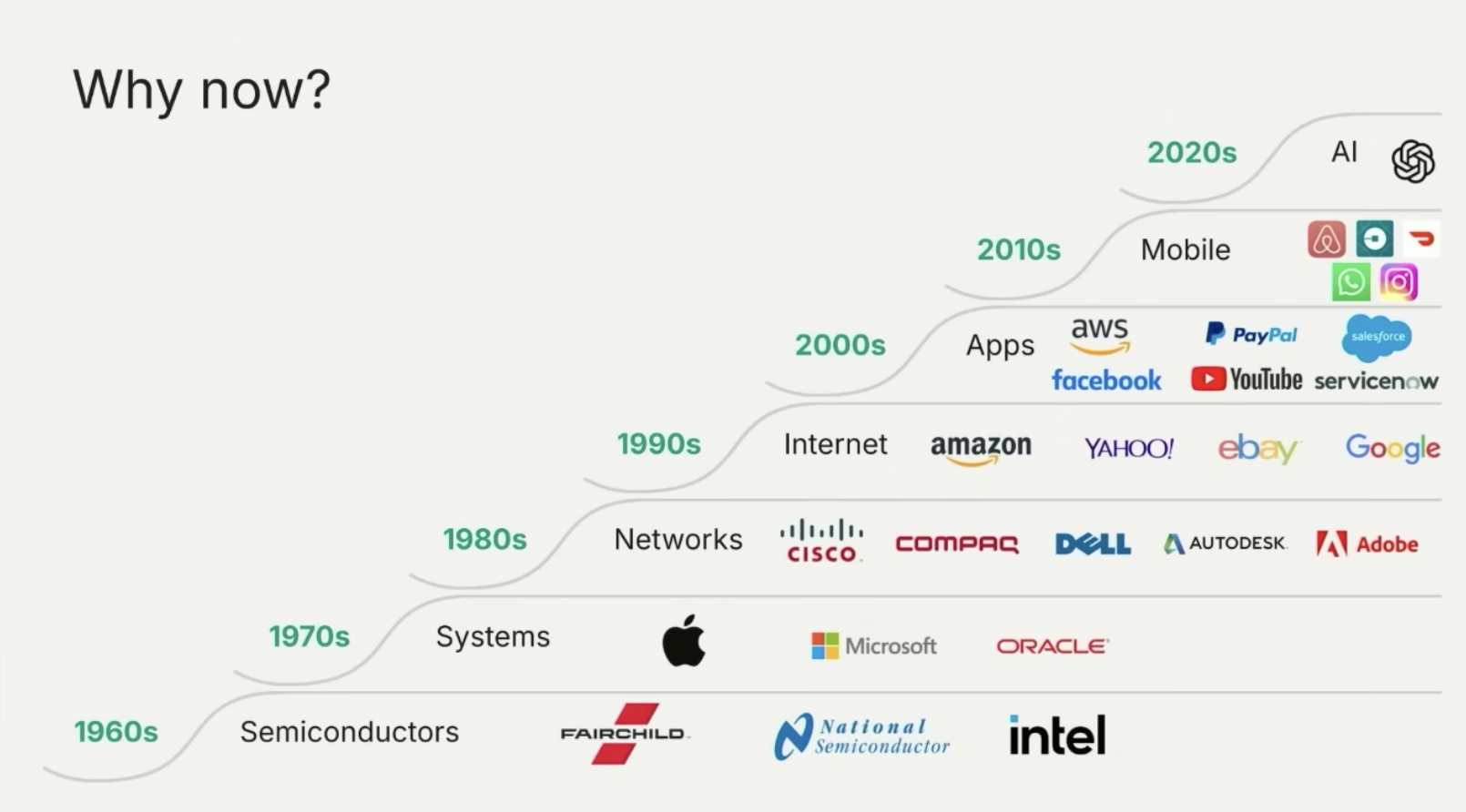
Part II — From Online to Intelligent: Tracing the Next Super‑Cycle

The Long Arc of “Getting Online” (1995–2025)
Twenty-nine years ago during the dot com boom, barely 1 in 40 people alive today had ever typed a URL. Since then things have changed quite a bit. The population of the internet has more than doubled in the last decade thanks to the rise of smartphones, from just 2.5B people in the early 2010’s.
Today, roughly 6.04 Billion people (73.2% of the 8.2B people alive) connect to the internet. It’s is no wonder why the internet feels like such a different place.
The New Baseline: "Intelligence”
After spending the last two decades watching the internet grow, it got me thinking. Can we do the same thing for the rise of artificial intelligence. Can we track the percent of people using A.I. currently and monitor the growth of it over time. So I started to pull some data.
Generative AI compressed the first decade of internet adoption into approximately two years:
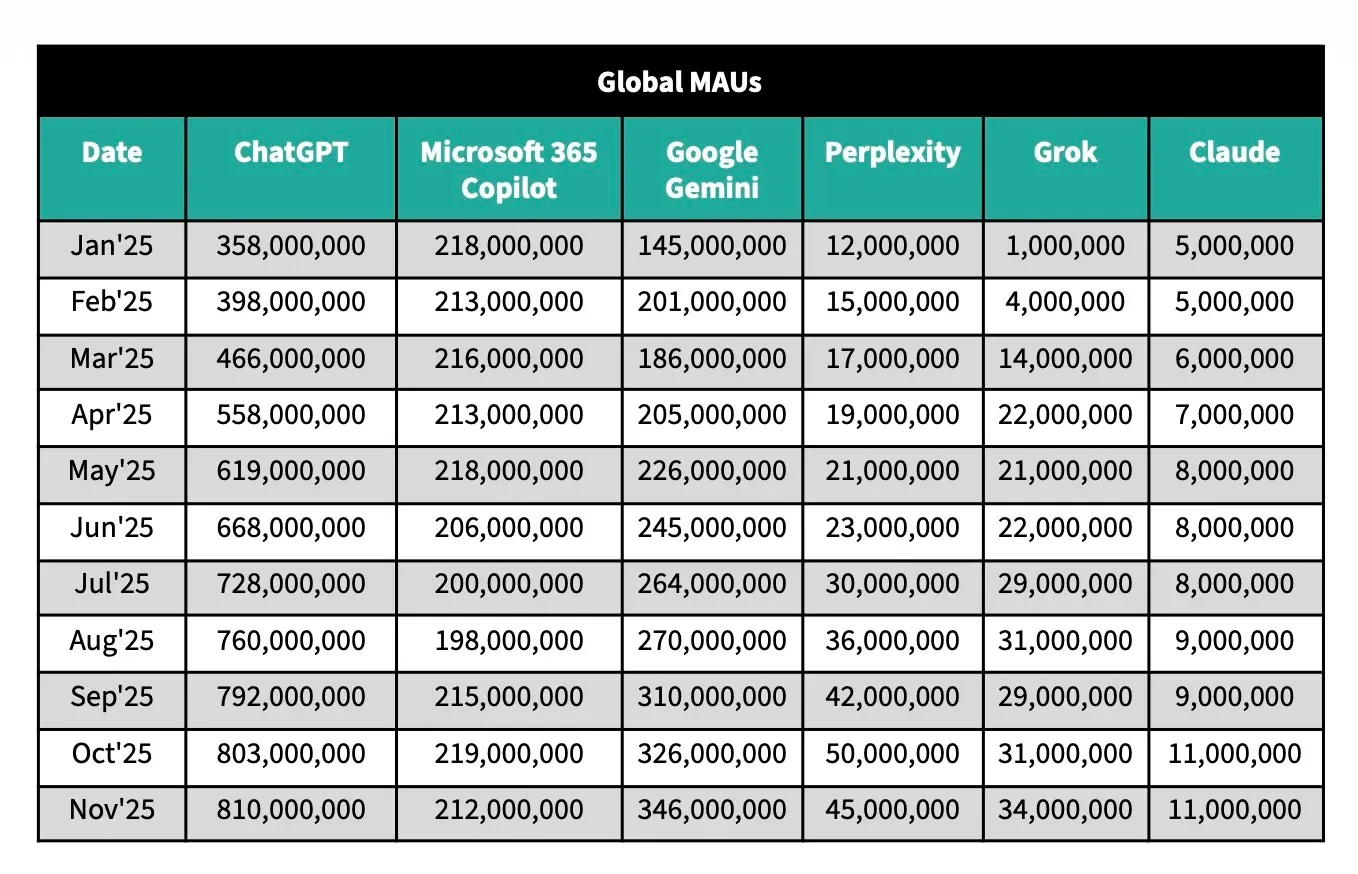
1.8 billion people (21% of global population) have consciously used an AI tool in the past six months.
If AI’s adoption curve mirrors the internet’s, we’re roughly at 2007; when only ~21% of people were online, before climbing to ~73% today.
ChatGPT alone boasts nearly 800 million monthly active users, with Google Gemini also claiming 350M monthly active users.
500–600 million people (6–7%) use AI daily.
Mapping the Next Decade: 2025 to 2035
If we focus on the connected world, AI already looks mainstream. The remaining climb is about the next few billion online people coming onto AI enabled devices, and about turning AI from a tool you try into invisible default infrastructure you rely on everyday.
Jeff Bezos electricity metaphor from 2007, a foundational, horizontal technology quietly embedding itself into every aspect of life and fading into the background like the electricity in our walls; is quickly becoming a reality.
If the next decade mirrors the internet arc, it is actually still early days. With AI adoption approaching today’s internet penetration by 2035. A plausible path looks like 2.5 billion users by 2027, 3.7 billion by 2029, 4.9 billion by 2031, and roughly 6 billion by 2035, which would be about 68% of the global population. Although, I would imagine this actually goes much faster due to the foundation the internet provides.
Why AI’s Adoption Curve Will Steepen:
Invisible Integration: AI will become deeply embedded in everyday applications—search, email, CRM, and smart speakers—requiring no special effort from users.
Cost Collapse: AI inference costs have already fallen dramatically and will continue dropping, democratizing access and enabling broader adoption.
Skeptic Conversion: Analysts expect more than half of today's generative AI skeptics to become regular users within the next few years.
Emergent Ubiquity: Nearly every device, from smartphones to cars, will soon ship with built-in AI capabilities.
The Early Innings of AI
Jason Shuman of Primary Venture Partners predicts that even the fastest growing vertical AI companies have barely scratched the surface of their markets. His simple math:
A vertical AI company that reaches $5M ARR quickly, with a $60K ACV, only needs about 83 customers. In a market with 100,000 qualified targets, that is about 0.08% penetration.
Across three common scenarios he modeled, the penetration remains tiny. In a $2B TAM with 33K target accounts, $5M ARR is about 0.25% penetration. In a $10B TAM with 166K accounts, it is about 0.05%. In a $30B plus TAM with 500K accounts, it is about 0.017%.
“The best products own data and orchestrate high impact daily workflows, and the wedge is often brutally simple: we sell you revenue.”
In one of my favorite talks of 2025, Sequoia predicts that with AI models ability to reason, they unlock a trillion dollar services market on top of SaaS (software as a service).
Conclusion: Your Future Inbox
By 2030, using software without AI assistance will feel outdated, akin to using a phone without a camera or app store today.
The intelligence wave isn't merely another tech trend. it's a fundamental change to humanity’s cognitive infrastructure.
The next super-cycle is already underway.

Booms, Busts, And Billion-Dollar Breakthroughs: Learning From 35 Years of Venture Capital Cycles
What’s Happened So Far:
To better understand where we are going, let’s first look at where we are coming from. From dial-up modems to foundational AI models, the venture capital (VC) and startup ecosystem has evolved through multiple cycles of rapid growth, dramatic busts, and revolutionary technological breakthroughs. Understanding these trends helps us navigate the current markets and accurately prepare for the future.
The Long Arc: 35 Years of Booms, Busts & Breakthroughs
A Brief History of Modern Venture Capital
Georges Doriot is credited as the “Father of Venture Capital” in 1946. Venrock, Greylock, CRV and others professionalized the asset class in the 1960’s, And according to the A Brief History of Modern Venture Capital “The 1970s and 1980s brought successful exits for VC investors and created some of today’s biggest companies: Apple, Genentech, FedEx, Microsoft, and Electronic Arts. In 1985, there were more than 290 active VC firms in the U.S., managing more than $17 billion AUM and 530 funds.”
1990–1994: Early Recovery & PC Era Beginnings
With the rise of personal computing, Venture Capital started to grow, with annual investments ranging from approximately $3 billion to $5 billion. Following a slowdown in the late 1980s, the industry began rebuilding, driven by innovations in personal computing, networking, and client-server technologies. The number of venture-backed startups rose from a few hundred at the decade's start to approximately 800–1,000 annually by 1994. Key IPOs included foundational tech companies like Cisco and Netscape, signaling early internet optimism and setting the stage for future expansion.
1995–1999: Dot-Com Boom (Web 1.0 Era)
The late 1990s saw explosive growth in venture capital investments, soaring from around $8 billion in 1995 to over $100 billion by 2000. The number of startups funded each year skyrocketed, growing from roughly 1,588 in 1995 to more than 4,000 by 1999. Notable companies like Amazon, eBay, Yahoo, and AOL epitomized this boom, capitalizing on rapid internet adoption. This era featured intense IPO activity and significant mergers and acquisitions as traditional companies embraced digital innovations.
2000–2004: Dot-Com Crash & Aftermath
The burst of the dot-com bubble resulted in an 80% drop in venture capital spending, falling from peaks exceeding $100 billion in 2000 to approximately $20 billion annually by 2002–2003. The annual number of funded startups plunged by more than half, severely contracting the ecosystem. Yet, this challenging period fostered resilience, allowing future tech giants like Google and PayPal to thrive and define the next era of technological innovation.
2005–2009: Web 2.0 & Social Media Emergence
Venture capital investments gradually recovered, climbing to over $30 billion by 2007, though they dipped again during the Global Financial Crisis of 2008–2009. Annual startup funding returned to around 4,000 deals by 2007. Prominent startups from this era included Facebook, YouTube, Twitter, and cloud computing innovators like AWS. The rise of early stage seed accelerators such as Y Combinator, TechStars, and Founder Institute significantly expanded early-stage startup opportunities. The iPhone is introduced on June 29, 2007 and the Apple App Store launched on July 10, 2008.
2010–2014: Mobile & Cloud Super-cycle
This era marked substantial expansion, with venture capital investments rising from $21.8 billion in 2010 to $56.4 billion by 2014. 1.94 billion people are now online in June 2010 and movie The Social Network comes out making entrepreneurship cool. Increased internet connectivity, Shark Tank and Dragon’s Den help bring startups mainstream around the world. The term "unicorn" is coined by Aileen Lee at Cowboy Ventures to describe privately held startups valued at over $1 billion, illustrating the ecosystem's growing maturity. Widespread adoption of mobile technology and cloud computing spurred significant IPOs, including Facebook and Twitter, bolstering investor confidence and market enthusiasm.
2015–2019: Unicorn Mania & Global Expansion
Venture capital reached record heights, surpassing $130 billion annually by 2018. Although the number of startups funded annually peaked and slightly declined thereafter, capital increasingly concentrated in larger deals. High-profile unicorns such as Uber, Airbnb, and WeWork captured attention, with global expansion notably in China and India. However, cautionary events like WeWork's failed IPO in 2019 signaled growing investor wariness. By 2019, half of the worlds population is now online.
2020–2021: Pandemic Bubble
Unprecedented fiscal stimulus and remote work adoption drove venture capital investments to historic levels, totaling $330 billion in the U.S. in 2021 alone. Startup funding reached record numbers, with over 19,000 companies financed in 2021. High valuations, rapid IPOs, and SPAC listings characterized this euphoric period. Venture Capital as an asset class is now installed globaly around the world. Notable IPOs included Coinbase, Rivian, and Robinhood, marking peak investor exuberance.
2022–2024: The Great Reset
Aggressive interest rate hikes to counter inflation significantly cooled venture activity, reducing annual investments to approximately $170 billion by 2023. Startup funding contracted dramatically, leading to widespread layoffs and closures. Nonetheless, the emergence of generative AI sparked renewed interest and investment, highlighting the resilience and adaptability of the tech ecosystem across new waves of innovation. Companies like OpenAI and Anthropic start attracting substantial attention, underscoring investor enthusiasm for new transformative technologies.

Where’s Venture Capital Heading Now?
So based on where we have been, where are we now? 2025 market sentiment seems to resemble the cautious optimism of 2004. The mobile web’s super cycle ended roughly 3 years ago and now a new wave of proliferating A.I. technology is starting the next one.
Available capital (dry powder) in venture funds exceeds $300 billion, exit markets are gradually reopening, and valuations have stabilized around half of their 2021 peaks. While investor-friendly term sheets have returned, emphasizing fundamental business metrics like revenue quality and capital efficiency.
As of February 2025, there are 5.56 billion individuals worldwide that are internet users, which now amounts to 67.9 % of the global population.
What’s Driving the Next Venture Capital Super-Cycle?
Artificial Intelligence (Foundational & Agentic): Expanded GPU availability, clearer regulatory frameworks, and rising enterprise AI budgets have made AI the primary investment theme, absorbing $131 billion globally in 2024 alone.
Fintech 2.0 (Embedded Financial Infrastructure): Innovations such as FedNow, PSD3, and open banking API’s position fintech infrastructure as essential financial plumbing, attracting stable and significant investment.
Climate Tech & Energy Transition: Regulatory incentives like the U.S. IRA and EU Green Deal have reignited investment, particularly in AI-driven climate solutions, despite broader funding declines. Record breaking times for new Fusion reactors get humanity closer and closer to cheaper energy.
Health Tech & Next-Gen Biotechnology: FDA approvals for gene-editing therapies and AI-driven advancements in protein folding are reshaping biotech investments, and what is even possible in the space. De-extinction of certain species might even be possible.
Robotics & Automation: Advances in AI-powered perception and control have revitalized robotics, with new leasing models driving adoption, particularly in logistics and defense sectors.
Key Insights for Founders & Investors
Capital Barbell: Premium valuations persist in foundational AI startups; other sectors must clearly demonstrate profitability paths. Larger checks are currently being allocated to fewer companies.
Exit Market: IPO opportunities are slowly re-emerging, but turmoil in the global markets are causing uncertainty.
Capital Discipline: Higher interest rates render "growth at all costs" strategies untenable. Companies need to do much more, with a lot less. Fortunately AI helps enable this, so those who adopt to the changing times with survive and thrive.
Talent & Infrastructure Costs: Anticipate elevated operational costs, especially regarding AI talent and computational infrastructure.
The Road Ahead
History shows that each downturn lays the groundwork for the next boom. With cautious optimism, the years 2025–2027 may usher in a new, sustainable cycle driven by AI-native applications, climate innovations, and countless new solutions.
Founders and investors must focus on delivering genuine economic value, innovative differentiation, and strategic alignment with evolving market conditions and regulatory landscapes.
Where do you think Venture Capital is heading next?

Where Did All the Veterans Go?
With Veterans Day upon us, I’ve had some thoughts. Maybe they provide some insight into the shifting cultural fabric of the United States—or maybe not. Either way, I found the data compelling.
With Veterans Day upon us, I’ve had some thoughts. Maybe they provide some insight into the shifting cultural fabric of the United States—or maybe not. Either way, I found the data compelling.
On Memorial Day earlier this year, I attended a ceremony held by the local legion post in my hometown. It’s a tradition I've participated in since I was a kid, typically involving a small parade with the local volunteer fire company, gun salute, a moment of silence, and veterans from the local legion post paying their respects. But this time, something was different. Fewer than ten veterans were present. The parade, usually a fixture of the event, was canceled because the few veterans who were able to attend either couldn’t—or chose not to—walk the short parade route.

Local Legion Post Memorial Day Service.
Seeing the dwindling number of attendees led me to wonder, "Where did all the veterans go?" This legion post was mostly veterans from World War II, Vietnam, and the Korean War. And it appeared there was almost no participation from younger veterans of Desert Storm, Afghanistan, or Iraq. So my curiosity got the best of me and I started to google the data to figure out what was going on.
According to PEW Research in November 2023, there are 18 million living veterans in the United States. In 1980, about 18% of U.S. adults were veterans, while today veterans represent about 6% of the country’s adult population.
In 2024, the veteran population has continued to decline. Veterans of the Gulf War era now represent the largest living segment of veterans, while the numbers from earlier conflicts are rapidly decreasing. Only around 100,000 World War II veterans remain, representing less than 1% of the current veteran population. The Department of Veterans Affairs estimates that the number of veterans will drop from today’s 18.3 million to 12.1 million in 2048 – a decrease of about 34%.
Interestingly, the decrease in veterans is also mirrored in our government. The percentage of congressional members who have served in the military is at a historic low, with only 18% of representatives and 17% of senators having military experience. This is a dramatic change from just a few decades ago, when more than three-quarters of Congress had worn the uniform.

I can’t help but feel that the steady decline in the veteran population reflects a larger cultural shift in America. The experiences of older generations—those who lived through the world wars or came of age during the draft—are no longer shared by the majority. Fewer families have a direct connection to military service, which can affect our collective understanding of the sacrifices made and the experiences lived by those who have served.
Supporting Veterans in New Ways:
Despite these shifts, I am encouraged by innovative ways to support and engage with the veteran community, like The Veteran Fund. This venture capital fund invests in military veterans starting companies, creating pathways for veterans to make impactful contributions outside of military service. At Finta, we recently hosted a panel as part of LA Tech Week, where David Kervin, a Venture Fund portfolio company joined us. David is the veteran founder of Proteus Space, which is revolutionizing satellite design with AI-driven platforms to reduce the time and cost of deploying satellites through automation and cutting-edge technology. You can take a listen to the event here.
a16z has also raised a fund supporting what a thesis they have coined as “American Dynamism”, which invests in founders and companies that support the national interest. Believing that mission-driven and civic-minded founders often build companies that transcend verticals and business models in their quest to solve important national problems.
Organizations like these help preserve the resilience, ingenuity, and dedication that veterans bring to our society.
I want to be clear: this reflection is not about advocating for war. I’m sensitive to the global conflicts that continue to impact people’s lives, often in devastating ways. Instead, I am simply reflecting on a cultural awareness, noticing that a part of our nation’s past identity might be slowly fading. The decline in the veteran population speaks to a shift away from the collective experience of service that once helped to shape our country. It's a reminder of how fragile and precious the values of service and sacrifice truly are.
This Veterans Day, I want to extend a heartfelt thank you to all veterans. Your service and sacrifice are fundamental parts of our nation’s story. Though the faces of America’s veteran community may be fewer, your contributions endure and continue to shape the lives of many. Thank you for your courage, resilience, and unwavering dedication.

Fundraising In 2024 - Three Sides Of The Table
During NY Tech Week 2024 Finta hosted a live panel discussion in midtown Manhattan on the state of fundraising in 2024. Delving deep into the nuances of fundraising from three different perspectives: an investor, a founder, and a lawyer.

Our incredible panel for this event consists of:
The Founder
David Silverstein, is the CEO of Ned, a white label lending platform that makes it easy for lenders to effortlessly deploy capital.
The Investor
Rachel ten Brink, General Partner at Red Bike Capital, an early-stage VC fund based in New York, specializing in SaaS, Health & Wellness, and Fintech sectors in the U.S. With over 30 years of experience, including founding a Y Combinator-backed startup that reached $100M in revenue and managing $2B in assets.
The Lawyer
Jack Sousa, is the Partner & Co-Chair of the Emerging Companies and Venture Capital Practice Group at Wiggin. He is also a wiggin(x) Co-Founder and Partner. Jack focuses his practice on venture capital, startup and early-stage companies and their financing needs.
Take A Listen To The Event:
Key Fundraising Insights From This Episode:
How Should Founders Think About Fundraising
David Silverstein kicked off the event emphasizes the importance of focus during a raise. Trying to shrink the amount of time you spend fundraising so you can get back to building the business. Highlighting the importance of relationship building in fundraising, while de-risking and hitting the right milestones to build trust with investors.
Rachel ten Brink advises founders to start planning their next round of funding as soon as they close their current round. She emphasizes the need to reverse-engineer the process, understanding how far the current funds will take the company and what metrics need to be hit for the next raise.
AI's Influence On Startups
AI will fundamentally transform the venture capital landscape. Rachel notes that AI is not just a sector but a foundational technology that will touch every industry. David adds that while AI is important, it is crucial to solve fundamental business problems first.
VC Investor Relations with LP's
Rachel discusses the current trends in VC strategies and the importance of understanding the dynamics between VC funds and their LPs. She highlights the necessity for founders to be aware of the financial health and commitments of the VCs they are pitching to.
Current Market Trends and Company Valuations
The discussion centers around the importance of always being prepared to fundraise and understanding market dynamics. David stresses the situational nature of fundraising, advising founders to be ready to adapt to market conditions.
Important Fundraising Legal Considerations
Jack Sousa recommends involving a lawyer early in the fundraising process to navigate complex legal terms and agreements. He mentions the return of redemption provisions and full ratchet anti-dilution clauses as trends to watch.
How Can Founder's Stand Out To Investors
To stand out, David suggests focusing on demonstrating real customer traction and needs. Rachel emphasizes the importance of clear, concise pitch decks and consistent communication with investors.
Strong Investor Communication
Balancing warm introductions and cold outreach is crucial. David recommends building relationships with investors before needing to raise funds, while Rachel highlights the importance of thoughtful signaling and avoiding desperate outreach.
Practical Tips for Founders
Jack Sousa and Rachel discuss essential legal terms, noting the increasing prevalence of liquidation preferences and full ratchet anti-dilution clauses. They advise founders to keep their cap tables clean and to be aware of the long-term implications of their fundraising choices.
Industry-Specific Insights
Raising funds for deep tech ventures involves unique challenges compared to traditional SaaS startups. Rachel and David emphasize the importance of understanding sector-specific milestones and investor expectations.
The End of Software...?
The panel debates whether the software market has matured. Rachel argues that while the market is evolving, there is still significant upside potential for innovative software solutions, particularly those integrating AI.
Hosting this event was a blast! A massive thank you to everyone who helped make this event happen and a success. We can't wait to see you all at the next one!

Memento Mori: 117 Billion People
Over 100+ billion humans have existed before us… Everyday we drive on roads, enter buildings, use technology, medicine and science whose existence is the result of contributions by billions of human lives that have come before us.

Over 100+ billion humans have existed before us…
When I first heard this number a few years ago, it was kind of mind blowing. Everyday we drive on roads, enter buildings, use technology, medicine and science whose existence is the result of contributions by billions of human lives that have come before us. We stand on the shoulders of 100+ billion humans who are no longer with us.
117 billion humans to be exact. Recent discoveries suggest that modern Homo sapiens existed much earlier than previously thought, around 200,000 B.C.E. This major shift in our understanding of human existence has led to the estimation that about 117 billion members of our species have ever been born on Earth. When considering this vast number, it's humbling to think about our individual significance and the marks we leave behind. But also, motivational, in some ways as well. In the words of the late Steve Jobs during his famous Stanford Commencement speech,
"Remembering that I'll be dead soon is the most important tool I've ever encountered to help me make the big choices in life. Almost everything—all external expectations, all pride, all fear of embarrassment or failure—these things just fall away in the face of death, leaving only what is truly important."
This perspective, deeply rooted in the Latin phrase Memento Mori, which translates to "remember you must die," serves as a powerful reminder of our mortality and the urgency to focus on what truly matters. Reflecting on how we can truly have a lasting legacy.
So how many humans are there alive today? As of 2024, the world population stands at 8.1 billion, reaching 8 billion in November 2022. It had taken all of human history until around 1800 for world population to reach one billion, the second billion was achieved in only 130 years (1930) thanks to the industrial revolution, the third billion in 30 years (1960), the fourth billion in 15 years (1974), and the fifth billion in only 13 years (1987). Society reached six billion in 11 years (1998), followed by seven billion in 12 years (2010).
During the 20th century alone, the population in the world has grown from 1.65 billion to 6 billion. In 1970, there were roughly half as many people in the world as there are now.

So what does being in the mix with 8 billion other people mean for our ability to leave a mark on the world? Well quite a lot actually, as there is a second historical trend happening at the same time as our explosive world population growth; the rise of the internet.
As of 2024 internet users worldwide reached 5.35 billion, only 66.2% of the global population. This number is expected to rise to 6.54 billion by 2025, thanks to the spread of internet access through affordable mobile phones. From a mere 1.97 billion internet users in June 2010, this growth is nothing short of revolutionary. For context, that means only 1/3 of people now online had internet access when most of us in the tech community had already started tweeting in the late 2000’s…
The finite nature of our time on earth is undeniable. Yet, it's this very limitation that underscores the unprecedented opportunity available to us today. With today's connectivity, individuals have the potential to impact lives on a scale never before imaginable. From sharing knowledge to fostering global movements, the digital age is democratizing influence.
Personally, I'm on a mission to use my time to improve the lives of at least 1 billion people. I’ve shared this goal before in my previous reflections, and it is grounded in the belief that by helping founders and innovators reach their potential, their creations can, in turn, benefit humanity at large, thus improving the lives of 1 billion. It's a mission that I'm deeply passionate about.

In the grand scheme of the universe's timeline, our lives are but brief flickers of existence. Yet, it's within this brevity that we find our most profound opportunity to make an impact. The digital age has gifted us with tools of unprecedented power—the power to connect, to share, and to change the world in ways we're just beginning to understand.
As we navigate this golden age of connectivity, let’s carry the essence of Memento Mori with us—not as a morbid fixation on death, but as a vibrant call to live fully and to leave an indelible positive mark on the tapestry of humanity.
So, what will your impact be? How will you use the precious time you have to create, inspire, and transform the world around you? The clock is ticking, and the digital stage is set. The only question that remains is, what will you do with this unparalleled moment in human history?
Finta is on Product Hunt Today!
Finta is on Product Hunt today! 🥳 We are constantly improving the product with your feedback. So very grateful to the Product Hunt community today and massively appreciate any upvotes! 😻
Finta is on Product Hunt today! 🥳 We are constantly improving the product with your feedback. So very grateful to the Product Hunt community today and massively appreciate any upvotes! 😻
We have been building Finta to be your one fundraising app to replace them all - giving users all the tools they need to streamline the fundraising process end to end so that founders can focus on building real investor relationships. We’ve been working on building and growing Finta over the last year and we’ve had a fantastic response from our users so far. We’re proud to say that we’ve helped founders raise millions of dollars!
In addition to our (actually useful) free-forever plan features, we’re giving a FREE MONTH OF PREMIUM FEATURES for our Product Hunt launch! We now have:
✅ Secure deal rooms that can be shared with a single link.
✅ Deal rooms allow you to attach and include due diligence docs in a single place.
✅ Automated CRM that moves contacts through the funnel automatically as they use your deal room.
✅ Automatic scriptwriting for your email outreach.
✅ Investor database that you can get matched with the best quality investors for your company.
… and a lot more!
Would love to know your thoughts and any feedback, as we are constantly improving Finta and your feedback will have a big impact :) Thank you so much!

Product Hunt is a curation of the best new products, every day. Letting you discover the latest mobile apps, websites, and technology products that everyone's talking about. Thank you again for your constant support!.

How Lorenzo Thione Is Scaling Support For Diverse Founders With Gaingels
Lorenzo Thione is the Managing Director of Gaingels, a leading LGBTQIA+/Allies investment syndicate and one of the largest and most active private investors in North America. He is also the co-founding Chairman of StartOut, Chairman of the Board at Social Edge, and previously co-founded Powerset, a natural-language search engine startup sold to Microsoft for $100 million in 2008.

Lorenzo Thione, Managing Director of Gaingels
We sat down with one of the most influential people in tech, Lorenzo Thione, who shares his very inspiring journey and how that led him to be where he is today.
Lorenzo grew up in Milan, Italy and had a technical background at an early age. He completed his studies at the University of Texas at Austin, from which he holds a M.S. in Computer Engineering.
He is now the Managing Director of Gaingels, a leading LGBTQIA+/Allies investment syndicate and one of the largest and most active private investors in North America. He is also the co-founding Chairman of StartOut, Chairman of the Board at Social Edge, and previously co-founded Powerset, a natural-language search engine startup sold to Microsoft for $100 million in 2008.
Lorenzo is named one of the most influential LGBT people in tech in 2014 and 2018 and his dedication in supporting and elevating leaders of the LGBTQ+ in the venture startup is amazing.
As the Managing Producer at Sing Out, Louis! Productions, he is also a Tony-Award winner (Hadestown, The Inheritance). He produced and co-created the Broadway musical, Allegiance starring George Takei and Lea Salonga. He is currently working in a new original musical, Indigo, as well as The Elephant Whisperer.
We covered a lot of ground in this episode, including:
Topics Discussed:
Where his passion comes from and how Lorenzo found entrepreneurship.
Helping others to build a diverse company by providing more than just funding.
The different companies that he had a part in building.
His mark on Broadway.
How your descent can make a difference in your future and your thinking.
How the model of angel groups is evolving to syndicates and SPV’s.
The role of a “Platform” strategy to help Gaingels portfolio companies.
What does Lorenzo think about the future of Venture Capital.
Quote of the Episode:
“Strategic Value, what is all being brought to the table”
The Greatest Piece of Advice:
His mentor told him to, “ be obsessive, about how you can add value, to your own network and relationships”
Links & show notes from this episode:
Ambition Today Is Proudly Independent & Supported By:
Finta - Finta’s end to end fundraising management platform enables you to manage your investors throughout their entire lifecycle in a single streamlined flow.
A-List: After every episode of the Ambition Today podcast we record an exclusive bonus clip, where we ask each guest to tell us the best advice they have ever received. Hear first-hand stories from over 30 entrepreneurs and investors in these exclusive bonus clips.
Listen to Ambition Today now:






Thank you for listening!
Thank you so much for listening and applying these useful tips and strategies to your life! If you have a chance, please drop by and leave a review for the show on iTunes by clicking here. Also, who should I interview next? Please let me know on Twitter or in the comments. Do you enjoy this podcast? If so, please leave a short review in the comments below. It keeps me going! 🤗

Millennial Investing Podcast Episode: Venture Capital Investing With Kevin Siskar
Last month I had the opportunity to sit on the opposite sit of the podcaster’s table to be a guest on the Millennial Investing Podcast! Where hosts, Robert Leonard and Clay Finck interview successful entrepreneurs, business leaders, and investors to help educate and inspire the millennial generation.

Kevin Siskar, Millenial Investing Podcast
Recently, I had the opportunity to sit on the opposite sit of the podcaster’s table to be a guest on the Millennial Investing Podcast! Where hosts, Robert Leonard and Clay Finck interview successful entrepreneurs, business leaders, and investors to help educate and inspire the millennial generation.
I hope you enjoy the episode. Listen here!
Host Clay Finck chats with Kevin Siskar about venture capital investing, the types of companies emerging in the venture capital space, how studying human behavior can help you as an investor, the differences between working at a large corporation vs a smaller company, how you can shift yourself to have a growth mindset, how luck has played into the companies Kevin has worked with, and much, much more!
Topics Discussed:
· What types of companies 43North looks to invest in.
· Why tech incubators should be everywhere, not just in Silicon Valley.
· What types of industries are currently most exciting from Kevin’s point of view.
· How studying human behavior can help you as an investor.
· What Kevin wishes he could tell his younger self about investing in startups.
· The differences between working at a large corporation and working at a smaller company.
· How people can shift from a worker mindset to a growth mindset.
· How luck has played into the companies that Kevin has worked with.
· The importance of a strong network and how Kevin maintains such a wide network.
· And much, much more!

How Jordan Levy Left His Mark On The Venture Capital Industry
In the fall we sat down with one of the godfathers of Venture Capital, Jordan Levy, who shares his very inspiring founder story and how that led to his career as an investor.

Jordan Levy | SEed Capital Partners (SBNY)
In the fall we sat down with one of the godfathers of Venture Capital, Jordan Levy, who shares his very inspiring founder story and how that led to his career as an investor.
Jordan co-founded Software Distribution Services which was acquired by Ingram Micro, before going on to be a Partner on the early-stage investing team at SoftBank Capital (SBNY) for 16 years.
Jordan has served on the boards of BuzzFeed, TalkSpace, Work Market, ACV Auctions, and many others. Using his upbringing and religion to pay it forward (Tzedakah) to the community that he grew up in, in Buffalo, New York. Jordy also co-founded Z80 Labs, a startup incubator in Buffalo, and 43North, an accelerator that hosts an annual startup competition, investing $5M per year in Buffalo, NY. We cover a lot of ground in this episode, including:
Topics Discussed:
Building Software Distribution Services in the early days of venture capital.
How to think about the private vs public markets.
The intricacies of SPACs vs the IPO.
Lessons learned from decades of investments.
Betting on the first days of the internet and what has changed since.
Investing through the dot com boom and bust.
How ACV Auctions re-defined the auto market.
The importance of investing in people over markets, trends, and other aspects of the business.
Quote of the Episode:
“You invest in the people and I will always believe that” and “if you don’t think someone can take this company to the promised land, then don’t invest in them.”
The Greatest Piece of Advice:
As his grandmother passed down to him, “never go to bed angry with your wife.”
Links & show notes from this episode:
Ambition Today Is Proudly Independent & Supported By:
Finta - Finta’s end to end fundraising management platform enables you to manage your investors throughout their entire lifecycle in a single streamlined flow.
A-List: After every episode of the Ambition Today podcast we record an exclusive bonus clip, where we ask each guest to tell us the best advice they have ever received. Hear first-hand stories from over 30 entrepreneurs and investors in these exclusive bonus clips.
Listen to Ambition Today now:
Thank you for listening!
Thank you so much for listening and applying these useful tips and strategies to your life! If you have a chance, please drop by and leave a review for the show on iTunes by clicking here. Also, who should I interview next? Please let me know on Twitter or in the comments. Do you enjoy this podcast? If so, please leave a short review in the comments below. It keeps me going! 🤗

Productivity Today: Finding Your Flow for Maximal Productivity
Flow can transform your experience at work, as well as your productivity, satisfaction, and happiness. While there is no hard and fast rules for inducing flow, there are ways for you to recreate meaningful flow in your life. Join me as I share my methods for unlocking your potential at work and setting yourself up to be more productive with flow.
Surprise! I actually created two new classes with Skillshare this year and this one is all about how to enter the flow state of mind while working!
Flow is the state of being fully in the moment and completely immersed in an activity to the point of effectively disappearing into it. In it, there’s no conscious division between the doer and what’s being done—there’s only the doing.
Flow can transform your experience at work, as well as your productivity, satisfaction, and happiness. While there is no hard and fast rules for inducing flow, there are ways for you to recreate meaningful flow in your life. Join me as I share my methods for unlocking your potential at work and setting yourself up to be more productive with flow. You can take the online class for free here.
Together, you will:
Understand the meaning of flow
Find where flow already exists in your life
Analyze flow themes and build your personal flow strategy
Share these strategies amongst your team and encourage others to reach their full potential
A 10-year McKinsey study on flow and productivity found that top executives are five times more productive during flow. That’s a 500% increase in productivity.
Whether you’d like to increase your productivity at work or simply find joy in what you do, this class will provide you with the tools to harness flow in any scenario. I hope it helps and that you truly enjoy this masterclass in finding focus.

Productivity Optimization: Tips and Tools for Automating Your Workflows
Automation softwares are so important for becoming more efficient and creating meaningful output across your team. Join Kevin as he shares top productivity tools for automating your workflows, enabling you to refocus your energy on what you're passionate about and become the best version of yourself.
With over 55,000 students and over 1 million minutes watched on my previous Skillshare classes, I am excited to announce my newest class on how to set up workflow automations!
Automation softwares are so important for becoming more efficient and creating meaningful output across your team. Join me as I share top productivity tools for automating your workflows, enabling you to refocus your energy on what you're passionate about and become the best version of yourself. You can take the class free here.
Together, you will learn how to:
Measure your time in order to maximize your ROI
Determine the automation opportunities within your workflows
Plan and build your workflow automation, with tools like Zapier.
Re-measure your ROI to ensure you are actually saving time and energy
Maintain and monitor your automations for long term success
Whether you’re in a leadership position on your team or just starting out, this class will provide you with the tools to focus on what really matters and exercise your creativity in the process. I hope it helps and that you enjoy this automation masterclass.

My 2022 Predictions
Happy New Year to you and your family! In addition to well wishes for 2022, I also wanted to take a minute to kick off 2022 with some predictions for the year! Some of my own, but also let you know what predictions I am following from others.
Happy New Year to you and your family! In addition to well wishes for 2022, I also wanted to take a minute to kick off 2022 with some predictions for the year! Some of my own, but also let you know what predictions I am following from others.

Visited Moraine Lake in Alberta, Canada in 2021.
An investment theme I am closely watching as we head into 2022?
The Artificial Intelligence tools & APIs recently released for software developers enable an entirely new level of automation for software platforms. One example, GPT-3 is a text-based A.I. model from Elon Musk & Sam Altman’s company Open AI that you simply prompt with plain English text, and it will generate an incredibly accurate response. What is fascinating to me is how these AI models continuously improve, to the point that GPT-3 can now even code portions of your app for you, from something as simple as a prompt that says “create a user signup screen.” And within a few seconds, GPT-3 will write all the code, and the browser will render the page with a brand new, fully functioning signup screen. This simplicity and open access will unlock the door for a whole new generation of founders and builders.
What's a trend that is buzzy but will take some time in 2022?
Everyone is talking about the impending third phase of the internet called Web3, which the builders and users decentrally own, orchestrated with tokens. I love the concept of Decentralized Autonomous Organizations or DAOs as I believe they could be the next evolution of what a company is.
I do think the path blockchain technology is on will take the internet closer to this Web3 vision of the future. However, I have spent some time personally building in this space with my company Finta, which provides fundraising software to founders and diligence tools to investors. Finta originally started as a project called Equity Token and through that work, I have seen firsthand how important it is going to be for the SEC to modernize and clarify its securities regulations for a world where tokens can flow freely in a decentralized environment while still representing equity ownership.
Andresson Horowitz recently advocated that the U.S. government create some policy guidance for entrepreneurs to build within. Otherwise, these web3 innovations might happen outside U.S. borders.
What's a development in fundraising founders should know?
Venture Capital is at an all-time high. According to Crunchbase, “prior to 2021, global funding had not reached over $100 billion in a single quarter. Funding in 2021 has far superseded that amount, with the first quarter tracking at $135 billion, the second quarter reaching $159 billion, and the most recent quarter peaking at $160 billion.”
While access to capital is at an all-time high, and we live in a world where fundraising announcements receive constant glory in the press, the outside appearance to other startup founders can be that fundraising rounds constantly happen with little effort. But the data show’s that most founders log over 100 meetings with different investors to eventually secure the investment they need to safely have 18-24 months of runway in front of the company.
So I want founders to remember that they are not alone and should keep fundraising beyond any initial rejections. Don’t take the rejection personally and use the feedback to improve your pitch for the next investor. I find it has been helpful to get founders into the mindset of thinking about the fundraising process more like a sales process, but this time the product is just different. Instead of a good, you are selling equity in your company. The right investors for your company are out there; you just need to find them so they know you exist. Keep going!
Other 2022 Tech Predictions I Am Following:
Scott Belsky, the founder of Behance and Chief Product Officer at Adobe, put out a great article yesterday on the “10 Forecasts For The Near Future Of Tech”.
Every year Fred Wilson publishes his predictions for the next year and here is Fred’s predictions for 2022. I have to agree that the carbon and climate tech spaces are def heating up, from what I am seeing. What I love about how Fred does this each year is that he also recaps what he got right and wrong the previous year. You can read his 2021 as well.
Finally, The All In Podcast has become one of my favorite listens this past year, and the besties released their tech predictions for 2022 in the latest episode, which you can watch on Youtube or listen to the podcast. The whole episode is good, but a great segment worth listening to on payment rails in fintech, starting at the 27 min mark.
I hope you enjoy the new year and wish you the best of luck in 2022!